Chapter 5.1: Introduction to Graphs
A graph is one of the most versatile mathematical structures ever invented. It models relationships between things — roads between cities, friendships between people, connections between web pages. In USACO, graphs represent mazes, networks, and relationships between cows.
5.1.1 What Is a Graph?
A graph consists of:
- Vertices (also called nodes): the "things" (cities, cows, cells)
- Edges: the connections between them (roads, friendships)
This graph has 6 vertices (1–6) and 6 edges.
Visual: Graph Basics Reference
This reference diagram shows the key graph terminology — vertices, edges, directed vs undirected, weighted edges, and common graph properties — all in one view.
Types of Graphs
| Type | Description | Example |
|---|---|---|
| Undirected | Edges have no direction; if A-B, then B-A | Friendships |
| Directed | Edges go one way; A→B doesn't mean B→A | Twitter follows |
| Weighted | Edges have costs/distances | Road distances |
| Unweighted | All edges equal | Maze connections |
| Tree | Connected, no cycles, N-1 edges for N nodes | File system |
| DAG | Directed Acyclic Graph | Dependencies |
Most USACO Bronze/Silver problems use unweighted, undirected graphs or simple grids.
5.1.2 Graph Representation
The most important decision when coding a graph algorithm is how to store the graph.
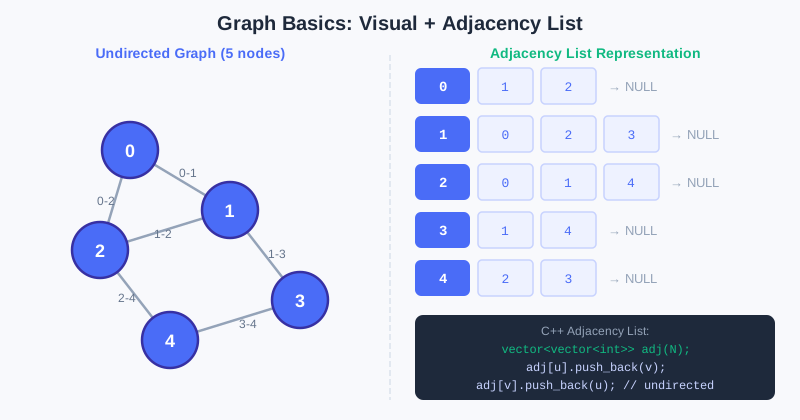
Visual: Graph Structure and Adjacency List
The left side shows an undirected graph with 5 nodes and their edges. The right side shows the adjacency list — for each node, a list of its neighbors. This representation uses O(V + E) space, which is optimal for sparse graphs typical in USACO problems.
Adjacency List (USE THIS)
Store each vertex's neighbors as a list. This is the standard in competitive programming.
#include <bits/stdc++.h>
using namespace std;

int main() {
    ios_base::sync_with_stdio(false);
    cin.tie(NULL);

    int n, m;  // n vertices, m edges
    cin >> n >> m;

    // adj[u] = list of vertices connected to u
    vector<vector<int>> adj(n + 1);  // 1-indexed: vertices 1..n

    for (int i = 0; i < m; i++) {
        int u, v;
        cin >> u >> v;
        adj[u].push_back(v);  // edge u → v
        adj[v].push_back(u);  // edge v → u (undirected: add both directions)
    }

    // Print adjacency list
    for (int u = 1; u <= n; u++) {
        cout << u << " -> ";
        for (int v : adj[u]) cout << v << " ";
        cout << "\n";
    }

    return 0;
}
Input:
6 6
1 2
1 3
2 4
3 5
4 6
5 6
Output:
1 -> 2 3
2 -> 1 4
3 -> 1 5
4 -> 2 6
5 -> 3 6
6 -> 4 5
Space complexity: O(V + E). For V = 10^5 and E = 2×10^5, this is fine.
Adjacency Matrix (When to Use)
A 2D array where adj[u][v] = 1 if there's an edge from u to v.
bool adj[1001][1001] = {};  // global, zero-initialized

// Add edge u-v
adj[u][v] = true;
adj[v][u] = true;  // undirected

// Check if edge exists: O(1)
if (adj[u][v]) { ... }
Space complexity: O(V²). For V = 10^5, that's 10^10 bytes — way too much! Only use for V ≤ 1000.
When to Use Which
| Condition | Use |
|---|---|
V ≤ 1000 and need O(1) edge lookup | Adjacency matrix |
| V up to 10^5 (or larger) | Adjacency list |
| Almost all pairs are connected (dense graph) | Adjacency matrix |
| Few edges compared to pairs (sparse graph) | Adjacency list |
Default in competitive programming: Always use adjacency list unless V is very small.
5.1.3 Reading Graph Input
USACO graphs come in several formats. Here are the patterns:
Standard: Edge List
5 4        ← n vertices, m edges
1 2        ← edge between 1 and 2
2 3
3 4
4 5
int n, m;
cin >> n >> m;
vector<vector<int>> adj(n + 1);
for (int i = 0; i < m; i++) {
    int u, v;
    cin >> u >> v;
    adj[u].push_back(v);
    adj[v].push_back(u);
}
Tree: Parent Array
5          ← n nodes
2 3 1 1    ← parent[2]=2, parent[3]=3, parent[4]=1, parent[5]=1 (node 1 is root)
int n;
cin >> n;
vector<vector<int>> children(n + 1);
for (int i = 2; i <= n; i++) {
    int parent;
    cin >> parent;
    children[parent].push_back(i);  // parent → child edge
}
Grid Graph
A grid where cells are nodes; edges connect adjacent cells (up/down/left/right):
4 4        ← rows × columns
....
.##.
....
....
int R, C;
cin >> R >> C;
vector<string> grid(R);
for (int r = 0; r < R; r++) cin >> grid[r];

// To iterate over neighbors of cell (r, c):
int dr[] = {-1, 1, 0, 0};  // row offsets for up/down/left/right
int dc[] = {0, 0, -1, 1};  // col offsets

for (int d = 0; d < 4; d++) {
    int nr = r + dr[d];  // neighbor row
    int nc = c + dc[d];  // neighbor col
    if (nr >= 0 && nr < R && nc >= 0 && nc < C) {
        // (nr, nc) is a valid neighbor
    }
}
5.1.4 Trees vs. Graphs
A tree is a special type of graph with these properties:
- N nodes and exactly N-1 edges
- Connected (every node reachable from every other)
Visual: Rooted Tree Structure
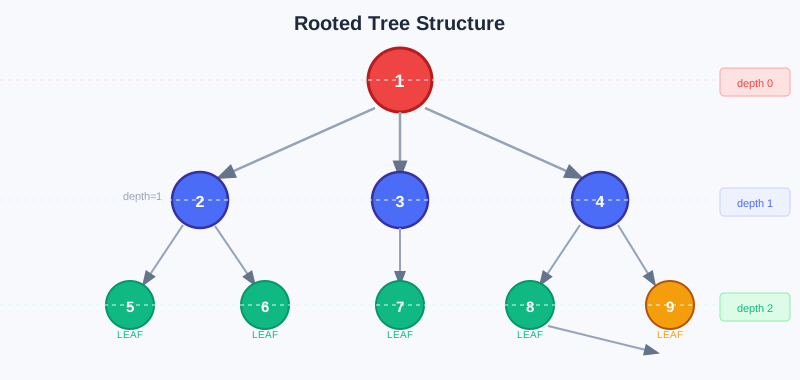
A rooted tree has a designated root node at depth 0. Each node has a parent (except the root) and zero or more children. Leaf nodes have no children. This structure naturally represents hierarchies and enables efficient tree DP algorithms.
- No cycles (acyclic)
Trees appear constantly in USACO — they represent hierarchies, family trees, and many other structures.
        1          ← root
       / \
      2   3
     / \   \
    4   5   6
Key tree vocabulary:
- Root: The topmost node (usually node 1)
- Parent: The node directly above in the hierarchy
- Children: Nodes directly below
- Leaf: A node with no children
- Depth: Distance from the root (root has depth 0)
- Height: Length of the longest path from a node to a leaf
Representing a Rooted Tree
vector<vector<int>> children(n + 1);  // children[u] = list of u's children
int parent[n + 1];

// Read tree as undirected graph, then root it with DFS
vector<vector<int>> adj(n + 1);
for (int i = 0; i < n - 1; i++) {
    int u, v;
    cin >> u >> v;
    adj[u].push_back(v);
    adj[v].push_back(u);
}

// Root at node 1 using DFS
fill(parent + 1, parent + n + 1, 0);
function<void(int, int)> root_tree = [&](int u, int par) {
    parent[u] = par;
    for (int v : adj[u]) {
        if (v != par) {
            children[u].push_back(v);
            root_tree(v, u);  // recursive DFS
        }
    }
};
root_tree(1, 0);
5.1.5 Weighted Graphs
For weighted graphs (edges with costs), store the weight alongside each neighbor:
vector<vector<pair<int,int>>> adj(n + 1);
// adj[u] = list of {v, weight} pairs

// Add weighted edge u-v with weight w
adj[u].push_back({v, w});
adj[v].push_back({u, w});

// Iterate neighbors with weights
for (auto [v, w] : adj[u]) {
    cout << "Edge " << u << "-" << v << " weight " << w << "\n";
}
Chapter Summary
📌 Key Takeaways
| Concept | Key Points | Why It Matters |
|---|---|---|
| Graph | Vertices + edges; model "relationships" | Almost all USACO Silver+ problems involve graphs |
| Undirected | Add v to adj[u] and u to adj[v] | Forgetting both directions is the most common bug |
| Directed | Add only v to adj[u] | Twitter follows, dependency relations, etc. |
| Adjacency list | vector<vector<int>> adj(n+1) | Default choice, O(V+E) space |
| Adjacency matrix | bool adj[1001][1001] | Only use when V ≤ 1000 |
| Grid graph | 4-direction neighbors + boundary check | Most common graph input in USACO |
| Tree | Connected acyclic, N-1 edges | Special graph, supports efficient algorithms |
❓ FAQ
Q1: Why use vector<vector<int>> for adjacency list instead of linked lists?
A: C++
vectoruses contiguous memory, is cache-friendly, and is much faster than linked lists. In contests,listis almost never used;vector<vector<int>>is the standard approach.
Q2: Should graph vertices be 0-indexed or 1-indexed?
A: USACO problems are usually 1-indexed. Recommend declaring adjacency list with size
n+1:vector<vector<int>> adj(n+1). This wastes index 0 but makes code clearer and less error-prone.
Q3: What is the only difference between directed and undirected graphs?
A: When reading edges, undirected graphs add two (u→v and v→u), directed graphs add only one (u→v). The subsequent BFS/DFS code is identical.
Q4: Does a grid graph need an explicit adjacency list?
A: No! Grid graph "neighbors" can be computed implicitly via direction arrays
dr[]/dc[], no need to store an adjacency list—saves memory and is cleaner.
🔗 Connections to Later Chapters
- Chapter 5.2 (BFS & DFS) runs on the adjacency list built in this chapter—this chapter is a prerequisite for Chapter 5.2
- Chapter 5.3 (Trees & DSU) uses this chapter's tree representation and adds Union-Find
- Graph traversal from Chapters 5.1–5.2 is the foundation for "Tree DP" and "DP on DAG" in Chapters 6.1–6.3 (DP)
- Grid graph representation is used throughout the book—BFS shortest path, Flood Fill, grid DP, etc.
Practice Problems
Problem 5.1.1 — Degree Count Read an undirected graph with N vertices and M edges. Print the degree (number of edges) of each vertex.
Problem 5.1.2 — Is It a Tree? Read a connected graph. Determine if it's a tree (exactly N-1 edges and no cycles).
Problem 5.1.3 — Reachability Read a directed graph and two vertices S and T. Print "YES" if T is reachable from S following directed edges, "NO" otherwise. (You'll need DFS from Chapter 5.2 to fully solve this, but you can set it up now)
Problem 5.1.4 — Leaf Count Read a rooted tree. Count how many nodes are leaves (have no children).
Problem 5.1.5 — Grid to Graph Read an N×M grid. Cells with '.' are passable; '#' are walls. Print the number of edges in the implicit graph (connect adjacent '.' cells).
Visual: Graph Adjacency List
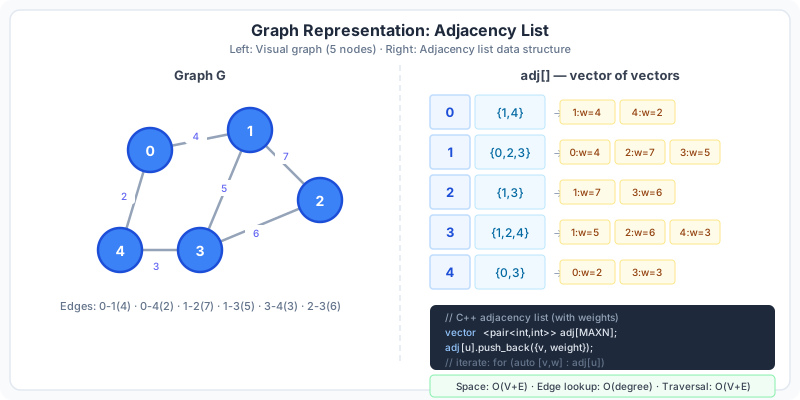
The left side shows a 5-node weighted graph visually. The right side shows the corresponding adjacency list in C++: vector<pair<int,int>> adj[] where each entry is a {neighbor, weight} pair. This is the standard representation for most USACO graph problems.