Chapter 3.3: Sorting & Searching
📝 Before You Continue: You should be comfortable with arrays, vectors, and basic loops (Chapters 2.2–2.3). Familiarity with
std::sortfrom Chapter 3.1 helps, but this chapter covers it in depth.
Sorting and searching are two of the most fundamental operations in computer science. In USACO, a huge fraction of problems become easy once you sort the data correctly. And binary search — the ability to search a sorted array in O(log n) — is a technique you'll reach for again and again.
3.3.1 Why Sorting Matters
Consider this problem: "Given N cow heights, find the two cows whose heights are closest together."
- Unsorted approach: Compare every pair →
O(N²). For N = 10^5, that's 10^10 operations. TLE. - Sorted approach: Sort the heights →
O(N log N). Then the closest pair must be adjacent! Check N-1 pairs →O(N). Total:O(N log N). ✓
💡 Key Insight: Sorting transforms many
O(N²)brute-force solutions intoO(N log N)orO(N)solutions. When you see "find the pair with property X" or "find the minimum/maximum of something involving two elements," always consider sorting first.
Complexity Analysis:
- Sorting:
O(N log N)time,O(log N)space (for the recursion stack in Introsort / quicksort) - After sorting: adjacent comparisons or two-pointer techniques are
O(N)
3.3.2 How Sorting Works (Conceptual)
You don't need to implement sorting algorithms yourself — std::sort does it for you. But understanding the ideas helps you reason about time complexity and choose the right approach.
Here are four classic sorting algorithms, each with an interactive visualization to help you understand how they work.
| Algorithm | Time Complexity | Space | Stable | Core Idea |
|---|---|---|---|---|
| Bubble Sort | O(N²) | O(1) | ✅ | Swap adjacent elements; large values "bubble" to the end |
| Insertion Sort | O(N²) / O(N) best | O(1) | ✅ | Insert each element into its correct position in the sorted region |
| Merge Sort | O(N log N) | O(N) | ✅ | Divide and conquer: split recursively, then merge |
| Quicksort | O(N log N) avg | O(log N) | ❌ | Divide and conquer: partition around a pivot, recurse |
🫧 Bubble Sort — O(N²)
Repeatedly scan the array, swapping adjacent elements that are out of order. Each pass "bubbles" the current maximum to the end:
Pass 1: [64,34,25,12,22,11,90] → 90 bubbles to end
Pass 2: [34,25,12,22,11,64,90] → 64 bubbles to second-to-last
...
Bubble sort is O(N²). Never use it on large inputs in competitive programming. We cover it only because it's conceptually the simplest.
🃏 Insertion Sort — O(N²) / O(N) best case
Divide the array into a left "sorted region" and a right "unsorted region." Each step takes the first element of the unsorted region and inserts it into the correct position in the sorted region:
Start: [64 | 34, 25, 12, 22, 11, 90]   ← | sorted on left
i=1:   [34, 64 | 25, 12, 22, 11, 90]   ← 34 inserted before 64
i=2:   [25, 34, 64 | 12, 22, 11, 90]   ← 25 inserted at front
i=3:   [12, 25, 34, 64 | 22, 11, 90]   ← 12 inserted at front
...
💡 Insertion sort's strength: Very fast on nearly-sorted arrays (approaches O(N)).
std::sortswitches to insertion sort for small subarrays.
void insertionSort(vector<int>& a) {
    int n = a.size();
    for (int i = 1; i < n; i++) {
        int key = a[i];   // element to insert
        int j = i - 1;
        // shift elements greater than key one position to the right
        while (j >= 0 && a[j] > key) {
            a[j + 1] = a[j];
            j--;
        }
        a[j + 1] = key;  // place key in its correct position
    }
}
🔀 Merge Sort — O(N log N) always
Divide and conquer: recursively split the array in half, then merge the two sorted halves back together:
[38, 27, 43, 3, 9, 82, 10]
        ↓ split recursively
[38,27,43,3]    [9,82,10]
[38,27] [43,3]  [9,82] [10]
[38][27][43][3] [9][82][10]
        ↓ merge bottom-up
[27,38] [3,43]  [9,82] [10]
  [3,27,38,43]    [9,10,82]
      [3,9,10,27,38,43,82] ✓
Merge sort is O(N log N) in all cases and is a stable sort.
void merge(vector<int>& a, int lo, int mid, int hi) {
    vector<int> tmp(a.begin() + lo, a.begin() + hi + 1);
    int i = lo, j = mid + 1, k = lo;
    while (i <= mid && j <= hi) {
        if (tmp[i - lo] <= tmp[j - lo])
            a[k++] = tmp[i++ - lo];  // take smaller from left half
        else
            a[k++] = tmp[j++ - lo];  // take smaller from right half
    }
    while (i <= mid) a[k++] = tmp[i++ - lo];  // append remaining left
    while (j <= hi)  a[k++] = tmp[j++ - lo];  // append remaining right
}

void mergeSort(vector<int>& a, int lo, int hi) {
    if (lo >= hi) return;
    int mid = lo + (hi - lo) / 2;
    mergeSort(a, lo, mid);       // sort left half
    mergeSort(a, mid + 1, hi);   // sort right half
    merge(a, lo, mid, hi);       // merge two sorted halves
}
⚡ Quicksort — O(N log N) average
Quicksort is one of the core algorithms underlying std::sort. Its key idea is divide and conquer:
- Pick a pivot element (typically the last element)
- Partition: move all elements ≤ pivot to the left, all > pivot to the right; pivot lands in its final position
- Recurse on the left and right subarrays
[8, 3, 6, 1, 9, 2, 7, 4]   ← pivot = 4
         ↓ partition
[3, 1, 2, 4, 9, 6, 7, 8]   ← 4 in final position; left ≤ 4, right > 4
 ↑_______↑  ↑  ↑__________↑
 left subarray  right subarray

Recurse on [3,1,2] → [1,2,3]
Recurse on [9,6,7,8] → [6,7,8,9]

Final: [1, 2, 3, 4, 6, 7, 8, 9] ✓
// Partition arr[lo..hi] using last element as pivot.
// Returns the final index of the pivot.
int partition(vector<int>& arr, int lo, int hi) {
    int pivot = arr[hi];   // choose last element as pivot
    int i = lo - 1;        // i points to end of "≤ pivot" region

    for (int j = lo; j < hi; j++) {
        if (arr[j] <= pivot) {
            i++;
            swap(arr[i], arr[j]);  // bring arr[j] into ≤ pivot region
        }
    }
    swap(arr[i + 1], arr[hi]);  // place pivot in its final position
    return i + 1;               // return pivot's index
}

void quickSort(vector<int>& arr, int lo, int hi) {
    if (lo >= hi) return;           // base case: subarray length ≤ 1
    int p = partition(arr, lo, hi); // p is pivot's final position
    quickSort(arr, lo, p - 1);      // sort left subarray
    quickSort(arr, p + 1, hi);      // sort right subarray
}
Visual: Quicksort Partition
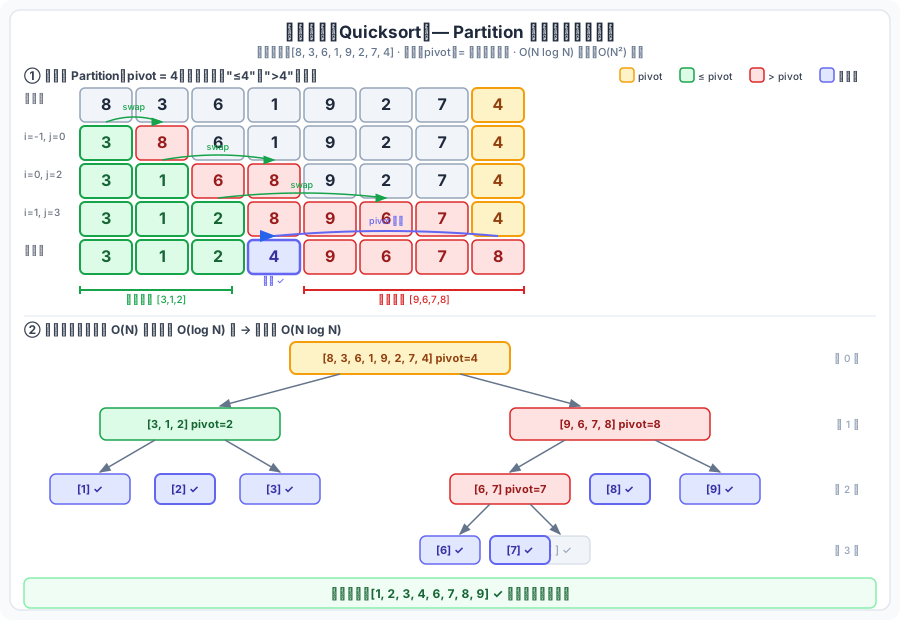
The diagram above illustrates how the partition operation rearranges elements around the pivot. Elements ≤ pivot move to the left; elements > pivot move to the right. The pivot then lands in its final sorted position.
⚠️ Worst case: If the pivot is always the max or min (e.g., already-sorted input), recursion depth degrades to O(N) and total time becomes O(N²).
std::sortavoids this via random pivot selection or median-of-three, guaranteeing O(N log N) worst case.
| Case | Time | Notes |
|---|---|---|
| Average | O(N log N) | Pivot roughly splits array in half |
| Worst | O(N²) | Pivot always extreme (sorted input) |
| Space | O(log N) | Recursion stack depth (average) |
3.3.3 std::sort in Practice
⚠️ Stability Note:
std::sortis NOT stable — it uses Introsort (Quicksort + Heapsort + Insertion sort hybrid), which does not preserve the relative order of equal elements. If you need stable sorting, usestd::stable_sortinstead (see the comparison table in this section).
#include <bits/stdc++.h>
using namespace std;

int main() {
    ios_base::sync_with_stdio(false);
    cin.tie(NULL);

    int n;
    cin >> n;
    vector<int> v(n);
    for (int &x : v) cin >> x;

    // Sort ascending
    sort(v.begin(), v.end());

    // Sort descending
    sort(v.begin(), v.end(), greater<int>());

    // Sort only part of a vector (indices 2 through 5 inclusive)
    sort(v.begin() + 2, v.begin() + 6);

    for (int x : v) cout << x << " ";
    cout << "\n";

    return 0;
}
Sorting by Multiple Criteria
Often you want to sort by one field, and break ties with another. With pair, this is automatic (sorts by .first, then .second):
vector<pair<int, string>> students;
students.push_back({85, "Alice"});
students.push_back({92, "Bob"});
students.push_back({85, "Charlie"});

sort(students.begin(), students.end());
// Result: {85, "Alice"}, {85, "Charlie"}, {92, "Bob"}
// Sorted by score first, then alphabetically by name
Custom Comparators
A comparator is a function that returns true if the first argument should come before the second in the sorted order.
The clearest way to write a comparator is as a standalone function:
struct Cow {
    string name;
    int weight;
    int height;
};

// Sort by weight ascending; break ties by height descending
bool cmpCow(const Cow &a, const Cow &b) {
    if (a.weight != b.weight) return a.weight < b.weight;  // lighter first
    return a.height > b.height;                             // taller first (tie-break)
}

int main() {
    vector<Cow> cows = {{"Bessie", 500, 140}, {"Elsie", 480, 135}, {"Moo", 500, 138}};

    sort(cows.begin(), cows.end(), cmpCow);

    for (auto &c : cows) {
        cout << c.name << " " << c.weight << " " << c.height << "\n";
    }
    // Output:
    // Elsie 480 135
    // Bessie 500 140
    // Moo 500 138
    return 0;
}
💡 Style Note: Defining
cmpas a standalone function (rather than an inline lambda) makes the sorting logic easier to read, test, and reuse — especially when the comparison involves multiple fields.
Sorting Algorithm Stability
⚠️ Important:
std::sortis NOT stable — equal elements may appear in any order after sorting. Usestd::stable_sortif relative order of equal elements must be preserved.
Sorting Algorithm Stability Comparison
| Algorithm | Time Complexity | Space Complexity | Stable | C++ Function |
|---|---|---|---|---|
| std::sort | O(N log N) | O(log N) | ❌ | sort() |
| std::stable_sort | O(N log² N) | O(N) | ✅ | stable_sort() |
| std::partial_sort | O(N log K) | O(1) | ❌ | partial_sort() |
| Counting Sort | O(N+K) | O(K) | ✅ | Manual |
| Radix Sort | O(d(N+K)) | O(N+K) | ✅ | Manual |
📝 Note:
std::sortuses Introsort (a hybrid of Quicksort + Heapsort + Insertion sort). Because Quicksort is not stable,std::sortmakes no guarantee on the relative order of equal elements. When you sort students by score and need students with the same score to remain in their original order, usestd::stable_sort.
Visual: Sorting Algorithm Comparison
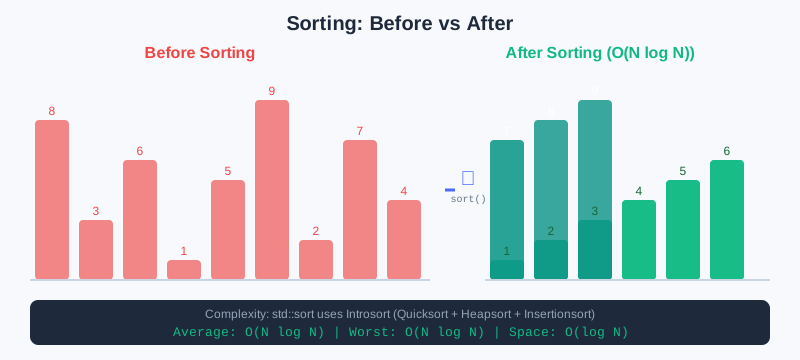
This chart compares the time complexity, space usage, and stability of common sorting algorithms, helping you choose the right one for each situation.
Counting Sort — O(N+K) for Small Value Ranges
When values are bounded integers in a small range [0, MAXVAL], counting sort beats std::sort by a wide margin:
// Counting sort: for integers in range [0, MAXVAL]
// Time O(N+MAXVAL), stable sort
void countingSort(vector<int>& arr, int maxVal) {
    vector<int> cnt(maxVal + 1, 0);
    for (int x : arr) cnt[x]++;
    int idx = 0;
    for (int v = 0; v <= maxVal; v++)
        while (cnt[v]--) arr[idx++] = v;
}
// USACO use case: faster than std::sort when value range is small (e.g., cow IDs 1-1000)
When to use counting sort in USACO:
- Cow IDs in range [1, 1000], N = 10^6 → counting sort is O(N + 1000) vs O(N log N)
- Grade values [0, 100] → trivially fast
- Color categories [0, 3] → instant
Caution: If MAXVAL is large (e.g., 10^9), counting sort requires O(MAXVAL) memory — don't use it. Coordinate compress first (Section 3.3.6), then count.
3.3.4 Binary Search
Binary search finds a target in a sorted array in O(log n) — instead of O(n) for linear search.
Analogy: Searching for a word in a dictionary. You don't start from A and read every entry — you open to the middle, check if your word is before or after, then repeat. Each step cuts the search space in half: after k steps, you've gone from N candidates to N/2^k. When N/2^k < 1, you're done — that takes k = log₂(N) steps.
💡 Key Insight: Binary search works whenever you have a monotone predicate — a condition that is
false false false ... true true true(or the reverse). You can binary search for the boundary between false and true inO(log N).
Visual: Binary Search in Action
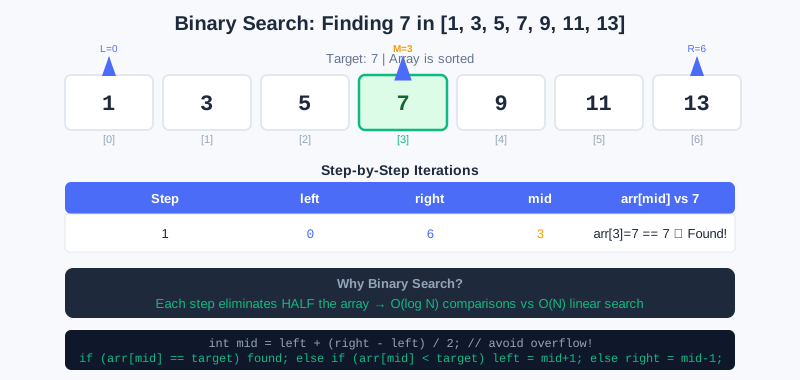
The diagram above shows a single-step binary search finding 7 in [1,3,5,7,9,11,13]. The left (L), right (R), and mid (M) pointers are shown. The key insight: computing mid = left + (right - left) / 2 avoids integer overflow compared to (left + right) / 2.
Manual Binary Search
// Solution: Binary Search — O(log N)
#include <bits/stdc++.h>
using namespace std;

// Returns index of target in sorted arr, or -1 if not found
int binarySearch(const vector<int> &arr, int target) {
    int lo = 0, hi = (int)arr.size() - 1;

    while (lo <= hi) {
        int mid = lo + (hi - lo) / 2;  // ← KEY LINE: avoid overflow (don't use (lo+hi)/2)

        if (arr[mid] == target) {
            return mid;         // found!
        } else if (arr[mid] < target) {
            lo = mid + 1;       // target is in the right half
        } else {
            hi = mid - 1;       // target is in the left half
        }
    }

    return -1;  // not found
}

int main() {
    vector<int> v = {1, 3, 5, 7, 9, 11, 13, 15};
    cout << binarySearch(v, 7) << "\n";   // 3 (index)
    cout << binarySearch(v, 6) << "\n";   // -1 (not found)
    return 0;
}
Step-by-step trace for searching 7 in [1, 3, 5, 7, 9, 11, 13, 15]:
lo=0, hi=7: mid=3, arr[3]=7 → FOUND at index 3 ✓

Searching for 6:
lo=0, hi=7: mid=3, arr[3]=7 > 6 → hi=2
lo=0, hi=2: mid=1, arr[1]=3 < 6 → lo=2
lo=2, hi=2: mid=2, arr[2]=5 < 6 → lo=3
lo=3 > hi=2: loop ends → return -1 ✓
Why lo + (hi - lo) / 2? If lo and hi are both large (close to INT_MAX), then lo + hi overflows! This formula is equivalent but safe.
The STL Way: lower_bound and upper_bound
These are almost always what you actually want in competitive programming:
// STL Binary Search Operations — all O(log N)
#include <bits/stdc++.h>
using namespace std;

int main() {
    vector<int> v = {1, 3, 3, 5, 7, 9, 9, 11};

    // lower_bound: iterator to first element >= target
    auto lb = lower_bound(v.begin(), v.end(), 3);
    cout << *lb << "\n";                    // 3 (first 3)
    cout << lb - v.begin() << "\n";         // 1 (index)

    // upper_bound: iterator to first element > target
    auto ub = upper_bound(v.begin(), v.end(), 3);
    cout << *ub << "\n";                    // 5 (first element after all 3s)
    cout << ub - v.begin() << "\n";         // 3 (index)

    // Count occurrences: upper_bound - lower_bound
    int count_of_3 = upper_bound(v.begin(), v.end(), 3)
                   - lower_bound(v.begin(), v.end(), 3);
    cout << count_of_3 << "\n";   // 2

    // Check if value exists
    bool exists = binary_search(v.begin(), v.end(), 7);
    cout << exists << "\n";  // 1

    // Find largest value <= target (floor)
    auto it = upper_bound(v.begin(), v.end(), 6);
    if (it != v.begin()) {
        --it;
        cout << *it << "\n";  // 5 (largest value <= 6)
    }

    return 0;
}
⚠️ Common Mistake: Using
lower_bound/upper_boundon an unsorted container. These functions assume sorted order — on unsorted data, they give wrong results with no error!
3.3.5 Binary Search on the Answer
This is one of the most powerful and commonly-tested techniques in USACO Silver. The idea:
Instead of searching for a value in an array, binary search over the answer space itself.
When does this apply? When:
- The answer is a number in some range [lo, hi]
- There's a function
canAchieve(X)that checks if X is feasible - The function is monotone: if X works, all values ≤ X also work (or all ≥ X work)
💡 Key Insight: Monotonicity means there's a "threshold" separating feasible from infeasible answers. Binary search finds this threshold in
O(log(hi-lo))calls tocanAchieve. If each call takesO(f(N)), total time isO(f(N) × log(answer_range)).
Classic Example: Aggressive Cows (USACO 2011 March Silver)
Problem: N stalls at positions p[1..N], place C cows to maximize the minimum distance between any two cows.
Why binary search? If we can place cows with minimum gap D, we can also place them with gap D-1. So feasibility is monotone: there's a threshold D* where ≥ D* is infeasible and < D* is feasible. We binary search for D*.
The canPlace(minDist) function: Place the first cow at the leftmost stall, then greedily pick the next stall that is at least minDist away. Count how many cows we can place this way — if ≥ C, return true.
// Solution: Binary Search on Answer — O(N log N log(max_distance))
#include <bits/stdc++.h>
using namespace std;

int n, c;
vector<int> stalls;

// Can we place c cows such that the minimum gap between any two cows is >= minDist?
bool canPlace(int minDist) {
    int placed = 1;           // place first cow at stall 0
    int lastPos = stalls[0];  // position of last placed cow

    for (int i = 1; i < n; i++) {
        if (stalls[i] - lastPos >= minDist) {  // this stall is far enough
            placed++;
            lastPos = stalls[i];
        }
    }
    return placed >= c;  // did we place all c cows?
}

int main() {
    ios_base::sync_with_stdio(false);
    cin.tie(NULL);

    cin >> n >> c;
    stalls.resize(n);
    for (int &x : stalls) cin >> x;
    sort(stalls.begin(), stalls.end());  // must sort first!

    // Binary search on the answer: what's the maximum possible minimum distance?
    int lo = 1, hi = stalls.back() - stalls.front();
    int answer = 0;

    while (lo <= hi) {
        int mid = lo + (hi - lo) / 2;
        if (canPlace(mid)) {
            answer = mid;    // mid works, try larger
            lo = mid + 1;
        } else {
            hi = mid - 1;    // mid doesn't work, try smaller
        }
    }

    cout << answer << "\n";
    return 0;
}
Trace for stalls = [1, 2, 4, 8, 9], C = 3:
Sorted: [1, 2, 4, 8, 9]
lo=1, hi=8

mid=4: canPlace(4)?
  Place cow at 1. Next stall ≥ 1+4=5: that's 8. Place at 8.
  Next stall ≥ 8+4=12: none. Total placed=2 < 3. Return false.
  → hi = 3

mid=2: canPlace(2)?
  Place cow at 1. Next stall ≥ 3: that's 4. Place at 4.
  Next stall ≥ 6: that's 8. Place at 8. Total placed=3 ≥ 3. Return true.
  → answer=2, lo=3

mid=3: canPlace(3)?
  Place cow at 1. Next ≥ 4: that's 4. Place at 4.
  Next ≥ 7: that's 8. Place at 8. Total placed=3 ≥ 3. Return true.
  → answer=3, lo=4

lo=4 > hi=3: done. Answer = 3
Another Classic: Minimum Time to Complete Tasks (Rope Cutting)
Problem: Given N ropes of lengths L[i], cut K ropes of equal length. What's the maximum length you can cut each piece to?
// Can we get K pieces of length >= len from the ropes?
bool canCut(vector<int> &ropes, long long len, int K) {
    long long count = 0;
    for (int r : ropes) count += r / len;  // pieces from each rope
    return count >= K;
}

// Binary search: maximize len such that canCut(len) is true
long long lo = 1, hi = *max_element(ropes.begin(), ropes.end());
long long answer = 0;
while (lo <= hi) {
    long long mid = lo + (hi - lo) / 2;
    if (canCut(ropes, mid, K)) {
        answer = mid;
        lo = mid + 1;
    } else {
        hi = mid - 1;
    }
}
Template for Binary Search on Answer:
// Generic template — adapt lo, hi, and check() for your problem
long long lo = min_possible_answer;
long long hi = max_possible_answer;
long long answer = lo;  // or -1 if no valid answer exists

while (lo <= hi) {
    long long mid = lo + (hi - lo) / 2;
    if (check(mid)) {       // mid is feasible
        answer = mid;       // save it
        lo = mid + 1;       // try to do better (or worse, depending on problem)
    } else {
        hi = mid - 1;       // mid not feasible, go lower
    }
}
🏆 USACO Tip: Whenever a USACO problem asks "find the maximum X such that [some condition]" or "find the minimum X such that [some condition]," consider binary search on the answer. This technique solves USACO Silver problems frequently.
3.3.6 Coordinate Compression
Sometimes values are large (up to 10^9), but there are few distinct values. Coordinate compression maps them to small indices (0, 1, 2, ...).
// Solution: Coordinate Compression — O(N log N)
#include <bits/stdc++.h>
using namespace std;

int main() {
    vector<int> A = {100, 500, 200, 100, 700, 200};

    // Step 1: Get sorted unique values
    vector<int> sorted_unique = A;
    sort(sorted_unique.begin(), sorted_unique.end());
    sorted_unique.erase(unique(sorted_unique.begin(), sorted_unique.end()),
                        sorted_unique.end());
    // sorted_unique = {100, 200, 500, 700}

    // Step 2: Map each original value to its compressed index
    vector<int> compressed(A.size());
    for (int i = 0; i < (int)A.size(); i++) {
        compressed[i] = lower_bound(sorted_unique.begin(), sorted_unique.end(), A[i])
                        - sorted_unique.begin();
        // 100→0, 200→1, 500→2, 700→3
    }

    for (int x : compressed) cout << x << " ";
    cout << "\n";  // 0 2 1 0 3 1

    return 0;
}
⚠️ Common Mistakes in Chapter 3.3
- Sorting with wrong comparator: Your lambda must return
trueifashould come BEFOREb. If it returnstruefora == b, you get undefined behavior (strict weak ordering violation). - Binary search on unsorted array:
lower_boundandupper_boundassume sorted order. On unsorted data, results are meaningless. - Off-by-one in binary search:
lo <= hivslo < himatters. When in doubt, test your binary search on a 1-element and 2-element array. - Wrong answer range in "binary search on answer": If the answer could be 0, set
lo = 0, notlo = 1. If it could be very large, make surehiis large enough (uselong longif necessary). - Integer overflow in mid computation: Always write
mid = lo + (hi - lo) / 2, never(lo + hi) / 2.
Chapter Summary
📌 Key Takeaways
| Operation | Method | Time Complexity | Notes |
|---|---|---|---|
| Sort ascending | sort(v.begin(), v.end()) | O(N log N) | Uses IntroSort |
| Sort descending | sort(..., greater<int>()) | O(N log N) | |
| Custom sort | Lambda comparator | O(N log N) | Must be strict weak order |
| Find exact value | binary_search | O(log N) | Returns bool |
| First index ≥ x | lower_bound | O(log N) | Returns iterator |
| First index > x | upper_bound | O(log N) | Returns iterator |
| Count of value x | ub - lb | O(log N) | |
| Binary search on answer | Manual BS + check() | O(f(N) log V) | V = answer range |
| Coordinate compression | sort + unique + lower_bound | O(N log N) | Map large values to small indices |
🧩 Binary Search Template Quick Reference
| Scenario | lo/hi init | Update rule | Answer |
|---|---|---|---|
| Maximize value satisfying condition | lo=min, hi=max | check(mid) → ans=mid, lo=mid+1 | ans |
| Minimize value satisfying condition | lo=min, hi=max | check(mid) → hi=mid | lo (when loop ends) |
| Floating-point binary search | lo=min, hi=max | Loop 100 times, check(mid) → hi=mid else lo=mid | lo ≈ hi |
❓ FAQ
Q1: Is sort's time complexity O(N log N) or O(N²)?
A: C++'s
std::sortuses Introsort (a hybrid of Quicksort + Heapsort + Insertion sort), guaranteeingO(N log N)worst case. No need to worry about degrading toO(N²). But note: if your custom comparator doesn't satisfy strict weak ordering, behavior is undefined (may infinite loop or crash).
Q2: What's the difference between lo <= hi and lo < hi in binary search?
A: The two styles correspond to different templates:
while (lo <= hi): when search ends, lo > hi, answer is stored inanswervariable. Good for "find target value" or "maximize value satisfying condition".while (lo < hi): when search ends, lo == hi, answer is lo. Good for "minimize value satisfying condition". Both can solve all problems; the key is pairing with the correct update rule. Beginners should pick one style and stick with it.
Q3: What problems is "binary search on answer" applicable to? How to identify them?
A: Three signals: ① The problem asks "the maximum/minimum X such that..."; ② There exists a decision function
check(X)that can determine feasibility in polynomial time; ③ The decision function is monotone (X feasible → X-1 also feasible, or vice versa). If all three hold, binary search on answer applies.
Q4: What is coordinate compression actually useful for?
A: When the value range is large (e.g., 10^9) but the number of distinct values is small (e.g., 10^5), coordinate compression maps large values to small indices 0~N-1. This lets you use arrays instead of maps (faster), or perform prefix sums/BIT operations over the value domain. Frequently needed in USACO Silver.
Q5: Why can't the sort comparator use <=?
A: C++ sorting requires the comparator to satisfy strict weak ordering: when a == b,
comp(a,b)must return false.<=returns true when a==b, violating this rule. The result is undefined behavior — may infinite loop, crash, or produce incorrect ordering.
🔗 Connections to Later Chapters
- Chapter 3.4 (Two Pointers): two-pointer techniques are often used after sorting — sort first
O(N log N), then two pointersO(N) - Chapter 3.2 (Prefix Sums): prefix sum arrays are naturally ordered, enabling binary search on them (e.g., find first prefix sum ≥ target)
- Chapters 4.1 & 5.4 (Greedy + Shortest Paths): Dijkstra internally uses a priority queue + greedy strategy, fundamentally related to sorting
- Chapter 6.2 (DP): LIS (Longest Increasing Subsequence) can be optimized to
O(N log N)using binary search - "Binary search on answer" is one of the most core techniques in USACO Silver, also frequently combined in Chapter 4.1 (Greedy)
Practice Problems
Problem 3.3.1 — Closest Pair 🟢 Easy Read N integers. Find the pair with the minimum difference. Print that difference.
Hint
Sort the array. The closest pair must be adjacent after sorting — scan pairs and take the minimum difference.Problem 3.3.2 — Room Allocation 🟡 Medium Read N events, each with start and end time. What is the maximum number of events that overlap at any single moment? (Hint: sort start/end times together and sweep)
Hint
Create an array of events: (time, +1 for start, -1 for end). Sort by time. Sweep and maintain a running count of active events; track the maximum.Problem 3.3.3 — Kth Smallest 🟡 Medium Read N integers. Find the K-th smallest element (1-indexed).
Solution sketch: Binary search on the answer X. Count how many elements ≤ X using a scan — this is O(N). Total: O(N log(max_value)).
Hint
Alternatively, just sort and return v[K-1]. But try the binary search approach for practice!Problem 3.3.4 — Aggressive Cows (USACO 2011 March Silver) 🔴 Hard
N stalls at positions p[1..N], place C cows to maximize the minimum distance between any two cows. (Full implementation of the example above.)
Solution sketch: Sort stalls. Binary search on minimum distance D. For each D, greedily place cows: always place next cow at the earliest stall that is ≥ D away from the last cow.
Hint
The check function `canPlace(D)` runs in `O(N)` by scanning sorted stalls greedily. Total time: `O(N log N)` sort + `O(N log(max_dist))` binary search.Problem 3.3.5 — Binary Search on Answer: Painter's Partition 🔴 Hard N boards with widths w[1..N]. K painters, each takes 1 unit time per unit width. Assign contiguous boards to painters to minimize total time (the maximum any single painter works).
Solution sketch: Binary search on the answer T (max time any painter works). Check: greedily assign boards to painters, starting a new painter whenever the current one would exceed T. If ≤ K painters suffice, T is feasible.
Hint
Feasibility check: simulate greedily — run left to right, assign boards to current painter until adding the next board would exceed T. `O(N)` per check, `O(log(sum))` binary search iterations.🏆 Challenge Problem: USACO 2016 February Silver: Fencing the Cows Fence all N points in a convex region using minimum fencing. This is the Convex Hull problem — look up the Graham scan or Jarvis march algorithms. While this is a Gold-level topic, thinking about it now will prime your intuition.
3.3.7 Advanced Binary Search on Answer — Three Examples
Example 1: Minimum Time to Finish Tasks (Parametric Search)
Problem: N workers, M tasks with effort[i]. Assign tasks to workers (each worker gets contiguous tasks). Minimize the maximum time any worker spends (minimize the bottleneck).
This is the "Painter's Partition" problem. Binary search on the answer (max time T), check if T is achievable.
// Check: can we distribute tasks among K workers so max work <= T?
bool canFinish(vector<int>& tasks, int K, long long T) {
    int workers = 1;
    long long current = 0;
    for (int t : tasks) {
        if (t > T) return false;  // single task exceeds T — impossible
        if (current + t > T) {
            workers++;             // start new worker
            current = t;
            if (workers > K) return false;
        } else {
            current += t;
        }
    }
    return true;
}

// Binary search on T
long long lo = *max_element(tasks.begin(), tasks.end());  // minimum possible T
long long hi = accumulate(tasks.begin(), tasks.end(), 0LL);  // maximum T (1 worker)

while (lo < hi) {
    long long mid = lo + (hi - lo) / 2;
    if (canFinish(tasks, K, mid)) hi = mid;  // mid works, try smaller
    else lo = mid + 1;                        // mid doesn't work, need larger
}
cout << lo << "\n";  // minimum possible maximum time
📝 Note: Here we binary search for the minimum feasible T, so we use
hi = midwhen feasible (notanswer = mid; lo = mid+1). The two templates are mirror images.
Example 2: Kth Smallest in Multiplication Table
Problem: N×M multiplication table. Find the Kth smallest value.
The table has values i*j for 1≤i≤N, 1≤j≤M. Binary search on the answer X: count how many values are ≤ X.
// Count values <= X in N×M multiplication table
long long countLE(long long X, int N, int M) {
    long long count = 0;
    for (int i = 1; i <= N; i++) {
        count += min((long long)M, X / i);
        // Row i has values i, 2i, ..., Mi
        // Count of values <= X in row i: min(M, floor(X/i))
    }
    return count;
}

// Binary search for Kth smallest
long long lo = 1, hi = (long long)N * M;
while (lo < hi) {
    long long mid = lo + (hi - lo) / 2;
    if (countLE(mid, N, M) >= K) hi = mid;
    else lo = mid + 1;
}
cout << lo << "\n";
Complexity: O(N log(NM)) — O(N) per check, O(log(NM)) iterations.
Example 3: USACO-Style Cable Length (Agri-Net inspired)
Problem: Given N farm locations, connect them all with cables. The cables must be at most length L. Find the maximum L such that you can form a spanning tree with all edges ≤ L.
// Binary search on maximum cable length L
// Check: does a spanning tree exist using only edges of length <= L?
// (This reduces to: is the graph connected when restricted to edges <= L?)
bool canConnect(vector<tuple<int,int,int>>& edges, int n, int L) {
    DSU dsu(n);
    for (auto [w, u, v] : edges) {
        if (w <= L) dsu.unite(u, v);
    }
    return dsu.components == 1;  // all nodes connected
}
3.3.8 lower_bound / upper_bound Complete Cheat Sheet
vector<int> v = {1, 3, 3, 5, 7, 9, 9, 11};
//                0  1  2  3  4  5  6   7

// ── lower_bound: first position >= x ──
lower_bound(all, 3)  → index 1  (first 3)
lower_bound(all, 4)  → index 3  (first element >= 4, which is 5)
lower_bound(all, 12) → index 8  (past-end: no element ≥ 12 exists in the array)

// ── upper_bound: first position > x ──
upper_bound(all, 3)  → index 3  (first element after all 3s)
upper_bound(all, 4)  → index 3  (same as above: no 4s)
upper_bound(all, 11) → index 8  (past-end)

// ── Derived operations ──
// Count occurrences of x:
ub(x) - lb(x) = upper_bound(all,3) - lower_bound(all,3) = 3-1 = 2 ✓

// Does x exist?
binary_search(all, x)  // O(log N), returns bool

// Largest value <= x (floor):
auto it = upper_bound(all, x);
if (it != v.begin()) cout << *prev(it);  // *--it

// Smallest value >= x (ceil):
auto it = lower_bound(all, x);
if (it != v.end()) cout << *it;

// Largest value < x (strict floor):
auto it = lower_bound(all, x);
if (it != v.begin()) cout << *prev(it);

// Count elements < x:
lower_bound(all, x) - v.begin()

// Count elements <= x:
upper_bound(all, x) - v.begin()

// Count elements in range [a, b]:
upper_bound(all, b) - lower_bound(all, a)
| Goal | Code | Note |
|---|---|---|
| First index ≥ x | lower_bound(v.begin(), v.end(), x) - v.begin() | Equals v.size() if all < x |
| First index > x | upper_bound(v.begin(), v.end(), x) - v.begin() | |
| Count of value x | upper_bound(...,x) - lower_bound(...,x) | |
| Largest value ≤ x | *prev(upper_bound(...,x)) | Check iterator ≠ begin |
| Smallest value ≥ x | *lower_bound(...,x) | Check iterator ≠ end |
| Does x exist? | binary_search(...) | Returns bool |
3.3.9 Custom Predicate Binary Search
For non-standard sorted structures or custom criteria:
// Binary search with custom predicate
// Find first index i where pred(i) is true, in range [lo, hi]
// Assumption: pred is monotone: false...false, true...true

int lo = 0, hi = n - 1, answer = -1;
while (lo <= hi) {
    int mid = lo + (hi - lo) / 2;
    if (/* some condition on mid */) {
        answer = mid;
        hi = mid - 1;  // look for smaller index
    } else {
        lo = mid + 1;
    }
}

// Example: first index where arr[i] >= arr[i-1] + 10 (gap >= 10)
int lo = 1, hi = n - 1, firstLargeGap = -1;
while (lo <= hi) {
    int mid = lo + (hi - lo) / 2;
    if (arr[mid] - arr[mid-1] >= 10) {
        firstLargeGap = mid;
        hi = mid - 1;
    } else {
        lo = mid + 1;
    }
}

// Floating point binary search (epsilon-based)
double lo_f = 0.0, hi_f = 1e9;
for (int iter = 0; iter < 100; iter++) {  // 100 iterations → error < 1e-30
    double mid = (lo_f + hi_f) / 2;
    if (check(mid)) hi_f = mid;
    else lo_f = mid;
}
// Answer: lo_f (or hi_f, they converge to same value)
🏆 USACO Pro Tip: "Binary search on answer" is one of the most common Silver techniques. When you see "maximize/minimize X subject to [constraint]," ask yourself: Is the feasibility function monotone? If yes, binary search.
3.3.10 Ternary Search — Finding the Peak of a Unimodal Function
Binary search requires a monotone predicate (false→true boundary). For unimodal functions (increases then decreases), use ternary search to find the maximum.
💡 When to use: A function
fis unimodal on[lo, hi]if it first strictly increases then strictly decreases (or is always one direction). Ternary search finds the maximum point inO(log((hi-lo)/eps))evaluations.
USACO appearances: Problems where the answer depends on a continuous parameter (e.g., "find the optimal point on a line to minimize the sum of distances to a set of points") sometimes require ternary search.
// Ternary search: find maximum of unimodal function f on [lo, hi]
// Prerequisite: f increases then decreases (unimodal)
// Time: O(log((hi-lo)/eps)) for continuous, or O(log N) for integers

// f must be declared/defined before calling this
double ternarySearch(double lo, double hi) {
    for (int iter = 0; iter < 200; iter++) {
        double m1 = lo + (hi - lo) / 3;
        double m2 = hi - (hi - lo) / 3;
        if (f(m1) < f(m2)) lo = m1;  // maximum is in [m1, hi]
        else hi = m2;                 // maximum is in [lo, m2]
    }
    return (lo + hi) / 2;  // Maximum point (lo ≈ hi after convergence)
}

// Integer ternary search (when f is defined on integers):
int ternarySearchInt(int lo, int hi) {
    // 使用 > 2 而非 >= 2:保留至少 3 个候选值再暴力枚举。
    // 当范围缩至 2 个元素时,m1 == m2(因为 (hi-lo)/3 == 0),
    // 会导致死循环。用 > 2 可确保安全退出并正确处理边界。
    while (hi - lo > 2) {
        int m1 = lo + (hi - lo) / 3;
        int m2 = hi - (hi - lo) / 3;
        if (f(m1) < f(m2)) lo = m1 + 1;
        else hi = m2 - 1;
    }
    // Check remaining candidates [lo, hi] (at most 3 elements)
    int best = lo;
    for (int x = lo + 1; x <= hi; x++)
        if (f(x) > f(best)) best = x;
    return best;
}
Contrast with binary search:
| Binary Search | Ternary Search | |
|---|---|---|
| Requires | Monotone predicate | Unimodal function |
| Finds | Boundary (false→true) | Peak (maximum/minimum) |
| Each step eliminates | Half the range | One-third of the range |
| Iterations for ε precision | log₂(range/ε) | log₃/₂(range/ε) ≈ 2.4× more |
⚠️ Note: Ternary search on integers requires care — use
while (hi - lo > 2)to avoid infinite loops when the range shrinks to 2 or 3 elements, then brute-force the remaining candidates.