Chapter 5.4: Shortest Paths
Finding the shortest path between nodes is one of the most fundamental problems in graph theory. It appears in GPS navigation, network routing, game AI — and most importantly for us, USACO problems. This chapter covers four algorithms (Dijkstra, Bellman-Ford, Floyd-Warshall, SPFA) and explains when to use each.
5.4.1 Problem Definition
Single-Source Shortest Path (SSSP)
Given a weighted graph G = (V, E) and a source node s, find the shortest distance from s to every other node.
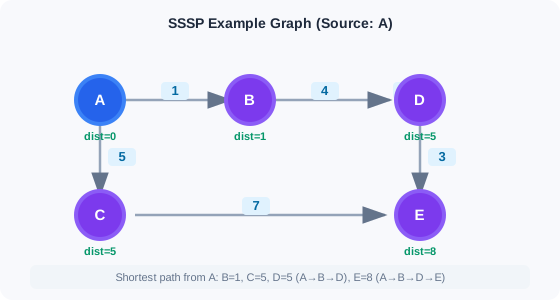
From source A:
dist[A] = 0dist[B] = 1dist[C] = 5dist[D] = 5(A→B→D = 1+4)dist[E] = 8(A→B→D→E = 1+4+3)
All-Pairs Shortest Path (APSP)
Find the shortest distance between every pair of nodes.
Why Not Just BFS?
BFS finds shortest paths in unweighted graphs (each edge = distance 1). With weights:
- Some paths have many short-weight edges
- Others have few large-weight edges
- BFS ignores weights entirely → wrong answer
5.4.2 Dijkstra's Algorithm
The most important shortest path algorithm. Used in ~90% of USACO problems involving weighted shortest paths.
Core Idea: Greedy + Priority Queue
Dijkstra is a greedy algorithm:
- Maintain a set of "settled" nodes (shortest distance finalized)
- Always process the unvisited node with smallest current distance next
- When processing a node, try to relax its neighbors (update their distances if we found a shorter path)
Why greedy works: If all edge weights are non-negative, the node currently at minimum distance cannot be improved by going through any other node (all alternatives would be ≥ current distance).
Step-by-Step Trace
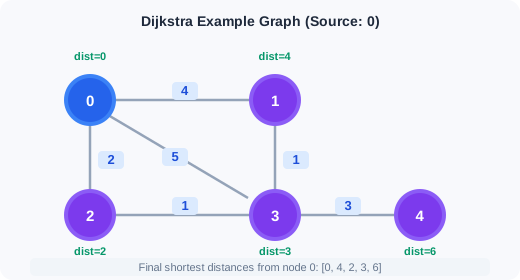
Start: node 0 | Initial: dist = [0, ∞, ∞, ∞, ∞]
| Step | Process Node | Relaxations | dist array | Queue |
|---|---|---|---|---|
| 1 | node 0 (dist=0) | 0→1: min(∞, 0+4)=4; 0→2: min(∞, 0+2)=2; 0→3: min(∞, 0+5)=5 | [0, 4, 2, 5, ∞] | {(2,2),(4,1),(5,3)} |
| 2 | node 2 (dist=2) | 2→3: min(5, 2+1)=3 ← improved! | [0, 4, 2, 3, ∞] | {(3,3),(4,1),(5,3_old)} |
| 3 | node 3 (dist=3) | 3→1: min(4, 3+1)=4 (no change); 3→4: min(∞, 3+3)=6 | [0, 4, 2, 3, 6] | {(4,1),(6,4),(5,3_old)} |
| 4 | node 1 (dist=4) | No relaxation possible | [0, 4, 2, 3, 6] | {(6,4)} |
| 5 | node 4 (dist=6) | Done! | [0, 4, 2, 3, 6] | {} |
Final: dist = [0, 4, 2, 3, 6]
Complete Dijkstra Implementation
📄 View Code: Complete Dijkstra Implementation
// Dijkstra's Algorithm (priority queue) — O((V+E) log V)
#include <bits/stdc++.h>
using namespace std;

typedef pair<int, int> pii;   // {distance, node}
typedef long long ll;

const ll INF = 1e18;          // use long long to avoid int overflow!
const int MAXN = 100005;

// Adjacency list: adj[u] = list of {weight, v}
vector<pii> adj[MAXN];

vector<ll> dijkstra(int src, int n) {
    vector<ll> dist(n + 1, INF);   // dist[i] = shortest distance to node i
    dist[src] = 0;

    // Min-heap: {distance, node}
    priority_queue<pii, vector<pii>, greater<pii>> pq;
    pq.push({0, src});

    while (!pq.empty()) {
        auto [d, u] = pq.top(); pq.pop();  // get node with minimum distance

        // KEY: skip outdated entries (a better path to u was already found)
        if (d > dist[u]) continue;

        // Relax all neighbors of u
        for (auto [w, v] : adj[u]) {
            ll newDist = dist[u] + w;
            if (newDist < dist[v]) {
                dist[v] = newDist;          // update distance
                pq.push({newDist, v});       // push updated entry into queue
            }
        }
    }
    return dist;
}
Key Points for Dijkstra
🚫 CRITICAL: Dijkstra does NOT work with negative edge weights! If any edge weight is negative, Dijkstra may produce incorrect results. The algorithm's correctness relies on the greedy assumption that once a node is popped from the priority queue (settled), its distance is final — negative edges break this assumption. For graphs with negative edges, use Bellman-Ford or SPFA instead.
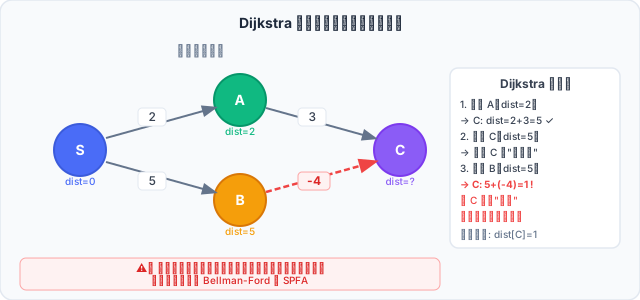
- Only works with non-negative weights. Negative edges break the greedy assumption.
- Use
long longfor distances when edge weights can be large.dist[u] + wcan overflowint. - Use
greater<pii>to makepriority_queuea min-heap. - The
if (d > dist[u]) continue;check is essential for correctness and performance.
5.4.3 Bellman-Ford Algorithm
A single-source shortest-path algorithm that is slower than Dijkstra but handles negative-weight edges and can even detect negative cycles.
Core Idea
Bellman-Ford does only one thing, and does it repeatedly:
Go through every edge; if using edge u→v makes
dist[v]smaller, updatedist[v]. This operation is called relaxation.
if (dist[u] != INF && dist[u] + w < dist[v]) {
    dist[v] = dist[u] + w;  // relax
}
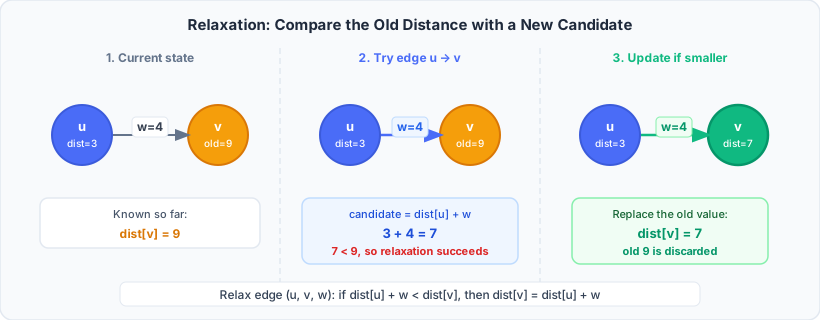
Relaxation is simple: given the distance to u, try "go to u first, then take the edge to v"; if that's shorter than the current distance to v, update it.
Why Repeat V-1 Rounds?
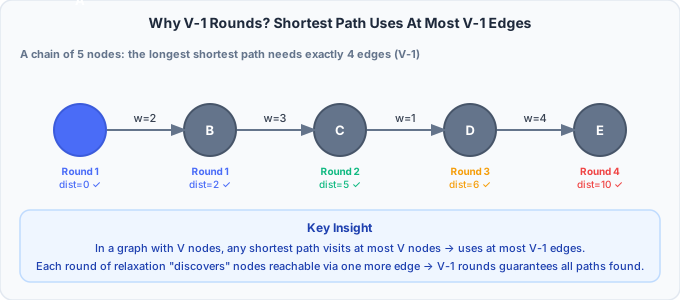
One round of relaxation can only propagate known distances one edge outward:
- After round 1: we've found every shortest path that uses at most 1 edge
- After round 2: every shortest path that uses at most 2 edges
- After round k: every shortest path that uses at most k edges
With no negative cycles, a shortest path never revisits a node and uses at most V-1 edges. So V-1 rounds are always enough.
Why Not Dijkstra?
Dijkstra finalizes a node's distance as soon as it's settled. But negative edges mean "a longer detour can still be shorter", breaking that assumption.
A → B weight 10, A → C weight 5, C → B weight -3
The shortest path from A to B is A→C→B = 2, not the direct A→B = 10. Dijkstra may lock in B=10 early and miss the better route.
Bellman-Ford never locks anything in early; every round re-examines every edge, so it handles negative weights correctly.
Step-by-Step Trace
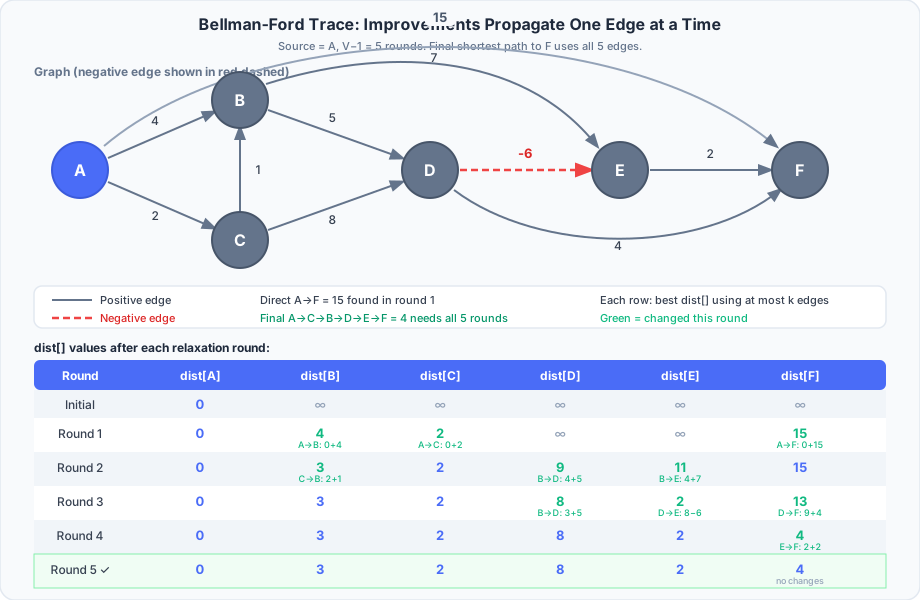
Edges: A→B(4), A→C(2), A→F(15), C→B(1), B→D(5), C→D(8), B→E(7), D→E(-6), D→F(4), E→F(2); source A.
| Round | dist[A] | dist[B] | dist[C] | dist[D] | dist[E] | dist[F] | Key changes |
|---|---|---|---|---|---|---|---|
| Init | 0 | ∞ | ∞ | ∞ | ∞ | ∞ | — |
| R1 | 0 | 4 | 2 | ∞ | ∞ | 15 | Direct hits on B, C, F |
| R2 | 0 | 3 | 2 | 9 | 11 | 15 | C→B improves B |
| R3 | 0 | 3 | 2 | 8 | 2 | 13 | B→D, then D→E(-6) chain |
| R4 | 0 | 3 | 2 | 8 | 2 | 4 | E→F gives final improvement |
| R5 | 0 | 3 | 2 | 8 | 2 | 4 | No change → converged |
Final shortest path: A→C→B→D→E→F = 2+1+5+(-6)+2 = 4.
Key takeaways:
- Direct ≠ shortest: F starts at 15, ends at 4
- Negative edges amplify improvements: once D becomes shorter, D→E(-6) slashes dist[E]
- V-1 rounds is an upper bound: 6 nodes allow at most 5 rounds; here we converged in round 4
Algorithm Outline
Bellman-Ford(src):
  1. dist[src] = 0, all others = ∞
  2. Repeat V-1 times: iterate every edge and try to relax
  3. One more pass: if any edge still relaxes → negative cycle exists
Negative Cycle Detection
A negative cycle is a cycle whose total weight is negative; looping around it makes the distance smaller every time, so no shortest path exists.
A→B(2), B→C(-5), C→A(1) → cycle total = -2
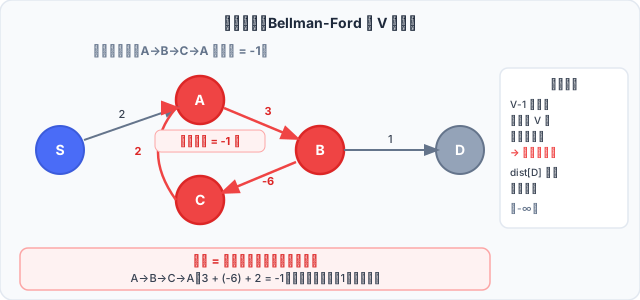
Detection method: after V-1 rounds, all shortest paths should have stabilized. If a V-th pass still relaxes an edge, a negative cycle reachable from the source exists.
for (auto& [u, v, w] : edges) {
    if (dist[u] != INF && dist[u] + w < dist[v]) {
        return {};  // negative cycle!
    }
}
⚠️ This method only detects negative cycles reachable from the source. To detect any negative cycle in the graph, use the "super-source" trick (see the SPFA section).
Complete Implementation
📄 View Code: Bellman-Ford Implementation
// Bellman-Ford Algorithm — O(V * E)
#include <bits/stdc++.h>
using namespace std;

typedef long long ll;
typedef tuple<int, int, int> Edge;  // {from, to, weight}

const ll INF = 1e18;

// Returns shortest-distance array, or empty if a negative cycle is detected
vector<ll> bellmanFord(int src, int n, vector<Edge>& edges) {
    vector<ll> dist(n + 1, INF);
    dist[src] = 0;

    for (int iter = 0; iter < n - 1; iter++) {
        bool updated = false;
        for (auto& [u, v, w] : edges) {
            if (dist[u] != INF && dist[u] + w < dist[v]) {
                dist[v] = dist[u] + w;
                updated = true;
            }
        }
        if (!updated) break;  // early convergence
    }

    // V-th pass: detect negative cycle reachable from the source
    for (auto& [u, v, w] : edges) {
        if (dist[u] != INF && dist[u] + w < dist[v]) {
            return {};  // negative cycle!
        }
    }

    return dist;
}
| Key Code | Purpose |
|---|---|
dist[u] != INF | Only expand from reachable nodes; avoids INF + w overflow |
updated flag | Early exit when a round produces no update |
| V-th pass | If still relaxable → negative cycle exists |
When to Use Bellman-Ford
- No negative edges → Dijkstra is faster
- Negative edges but no negative cycle, single-source shortest path → Bellman-Ford or SPFA
- Need to detect negative cycles reachable from the source → Bellman-Ford
- Very large graph → O(VE) may TLE; consider SPFA or other techniques
💡 In one sentence: Relax every edge each round; round k guarantees all shortest paths that use ≤ k edges, so V-1 rounds always converge. If the V-th pass still relaxes, a negative cycle exists.
5.4.4 Floyd-Warshall Algorithm
Computes shortest paths between all pairs of nodes in one go.
Core Idea: Try Every Node as a Relay
Imagine you want to find the shortest route between every pair of cities in a country. The simplest approach: for each pair (i, j), check if there's a direct road. But that only considers direct routes.
Key insight: the shortest path from i to j either goes directly, or passes through some relay node k:
shortest i→j = min( direct i→j, via relay i→k→j )
Floyd-Warshall systematizes this: try each node k as a relay and see if i→k→j is shorter than the current i→j.
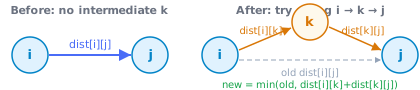
if (dist[i][k] + dist[k][j] < dist[i][j]) {
    dist[i][j] = dist[i][k] + dist[k][j];  // going via k is shorter, update
}
Step-by-Step Trace
4 nodes (0–3), 5 undirected edges: 0-1(3), 0-2(8), 1-2(2), 1-3(5), 2-3(1)
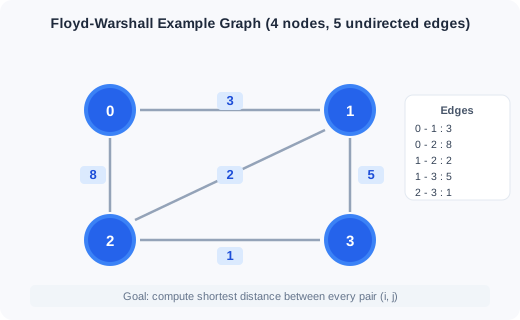
Initial distance matrix (only direct edges filled, no direct edge = ∞):
| dist | 0 | 1 | 2 | 3 |
|---|---|---|---|---|
| 0 | 0 | 3 | 8 | ∞ |
| 1 | 3 | 0 | 2 | 5 |
| 2 | 8 | 2 | 0 | 1 |
| 3 | ∞ | 5 | 1 | 0 |
k=0: Use node 0 as relay. Check all (i,j) pairs: can i→0→j beat i→j?
| i | j | i→0→j | current dist[i][j] | result |
|---|---|---|---|---|
| 1 | 2 | 3+8=11 | 2 | 11 ≥ 2, no update |
| 2 | 1 | 8+3=11 | 2 | 11 ≥ 2, no update |
| others | — | — | — | node 3 can't reach 0, skip |
k=0: no updates. Matrix unchanged.
k=1: Use node 1 as relay.
| i | j | i→1→j | current dist[i][j] | result |
|---|---|---|---|---|
| 0 | 2 | 3+2=5 | 8 | 5 < 8, update! dist[0][2]=5 |
| 0 | 3 | 3+5=8 | ∞ | 8 < ∞, update! dist[0][3]=8 |
| 2 | 0 | 2+3=5 | 8 | update (symmetric) |
| 3 | 0 | 5+3=8 | ∞ | update (symmetric) |
| 2 | 3 | 2+5=7 | 1 | 7 ≥ 1, no update |
Matrix after k=1:
| dist | 0 | 1 | 2 | 3 |
|---|---|---|---|---|
| 0 | 0 | 3 | 5 | 8 |
| 1 | 3 | 0 | 2 | 5 |
| 2 | 5 | 2 | 0 | 1 |
| 3 | 8 | 5 | 1 | 0 |
k=2: Use node 2 as relay.
| i | j | i→2→j | current dist[i][j] | result |
|---|---|---|---|---|
| 0 | 3 | 5+1=6 | 8 | 6 < 8, update! dist[0][3]=6 |
| 1 | 3 | 2+1=3 | 5 | 3 < 5, update! dist[1][3]=3 |
| 0 | 1 | 5+2=7 | 3 | 7 ≥ 3, no update |
Matrix after k=2:
| dist | 0 | 1 | 2 | 3 |
|---|---|---|---|---|
| 0 | 0 | 3 | 5 | 6 |
| 1 | 3 | 0 | 2 | 3 |
| 2 | 5 | 2 | 0 | 1 |
| 3 | 6 | 3 | 1 | 0 |
k=3: Use node 3 as relay. All checks yield no shorter paths. Matrix unchanged.
Final result: dist[0][3]=6 (path 0→1→2→3), dist[1][3]=3 (path 1→2→3)
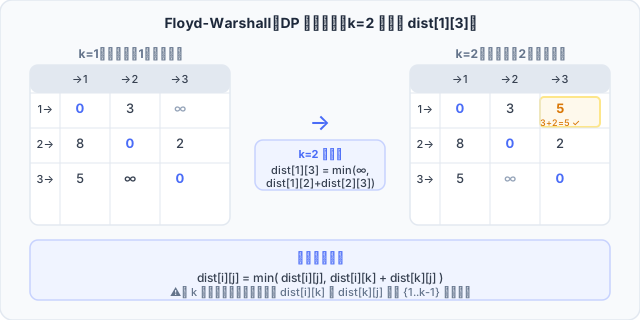
Why Must k Be the Outermost Loop?
This is the most common implementation mistake in Floyd-Warshall.
The key: when processing relay node k, dist[i][k] and dist[k][j] must still be the values computed before trying k as a relay (i.e., using only {0..k-1} as relays).
- k outermost ✅: When processing k, the i-j loops only read
dist[i][k]anddist[k][j]. These won't be modified during the current k-round (row k and column k depend only on {0..k-1}), so they're safe to use. - k innermost ❌: Within the same k-round, a just-updated
dist[i][k]gets read by a later (i', j') check, which is like "using k as a relay twice in the same round" — incorrect results.
Remember: k is outermost, i and j are inner — order matters!
Complete Implementation
📄 View Code: Floyd-Warshall Implementation
// Floyd-Warshall All-Pairs Shortest Path — O(V^3)
#include <bits/stdc++.h>
using namespace std;

typedef long long ll;
const ll INF = 1e18;
const int MAXV = 505;

ll dist[MAXV][MAXV];

void floydWarshall(int n) {
    // Initialize: dist[i][i]=0, edges set to weight, non-edges = INF
    // ... (done during input reading)

    // ⚠️ CRITICAL: k MUST be the OUTERMOST loop!
    for (int k = 1; k <= n; k++) {         // relay node
        for (int i = 1; i <= n; i++) {     // source
            for (int j = 1; j <= n; j++) { // destination
                if (dist[i][k] != INF && dist[k][j] != INF) {
                    dist[i][j] = min(dist[i][j], dist[i][k] + dist[k][j]);
                }
            }
        }
    }
    // If dist[i][i] < 0 after running, node i is on a negative cycle
}
| Key Code | Purpose |
|---|---|
k outermost | Ensures DP invariant: when processing k, only {1..k-1} have been used as relays |
dist[i][k] != INF | Prevents INF + w overflow |
dist[i][i] < 0 | Negative cycle detection: self-distance should be 0; < 0 means negative cycle |
When to Use Floyd-Warshall?
- Need all-pairs shortest paths and V ≤ 500 (V³ ≈ 1.25×10⁸ is borderline)
- V > 500: run Dijkstra from each source — O(V × (V+E) log V) is faster
- Need to detect graph-wide negative cycles: after running, check
dist[i][i] < 0 - Extremely short code: only 5 lines of core logic, great for small-V problems
💡 One-line summary: Try each node k as a relay — if i→k→j is shorter than current i→j, update. Triple loop, k must be outermost.
5.4.5 Algorithm Comparison Table
| Algorithm | Time Complexity | Negative Edges | Negative Cycles | Multi-Source | Best For |
|---|---|---|---|---|---|
| BFS | O(V + E) | ✗ No | ✗ No | ✓ Yes (multi-source BFS) | Unweighted graphs |
| Dijkstra | O((V+E) log V) | ✗ No | ✗ No | ✗ (run once per source) | Weighted, non-negative edges |
| Bellman-Ford | O(V × E) | ✓ Yes | ✓ Detects | ✗ | Negative edges, detecting neg cycles |
| SPFA | O(V × E) worst, O(E) avg | ✓ Yes | ✓ Detects | ✗ | Sparse graphs with neg edges |
| Floyd-Warshall | O(V³) | ✓ Yes | ✓ Detects (diag) | ✓ Yes (all pairs) | Dense graphs, all-pairs queries |
When to Use Which?
Graph has negative edges?
├── YES → Bellman-Ford or SPFA (or Floyd-Warshall for all-pairs)
└── NO  → V ≤ 500 and need all-pairs?
          ├── YES → Floyd-Warshall  O(V³)
          └── NO  → Unweighted graph (all edges = 1)?
                    ├── YES → BFS  O(V+E)
                    └── NO  → Edge weights only 0 or 1?
                              ├── YES → 0-1 BFS  O(V+E)
                              └── NO  → Dijkstra  O((V+E) log V)
5.4.6 SPFA — Bellman-Ford with Queue Optimization
In the previous section we learned Bellman-Ford: scan all edges every round, repeat V-1 rounds. You might wonder — most edges don't produce any relaxation in a given round, so scanning them is pure waste. SPFA fixes exactly this.
From Bellman-Ford to SPFA: An Intuition
What Bellman-Ford does each round: iterate all E edges and check which ones can relax.
But think about it: only a node u whose dist just decreased can possibly relax its neighbors v. If dist[u] didn't change this round, its neighbors won't improve either.
SPFA's core idea: whenever a node's distance is updated, enqueue it. When dequeuing a node, relax only its neighbors. Nodes whose distances haven't changed are simply ignored.
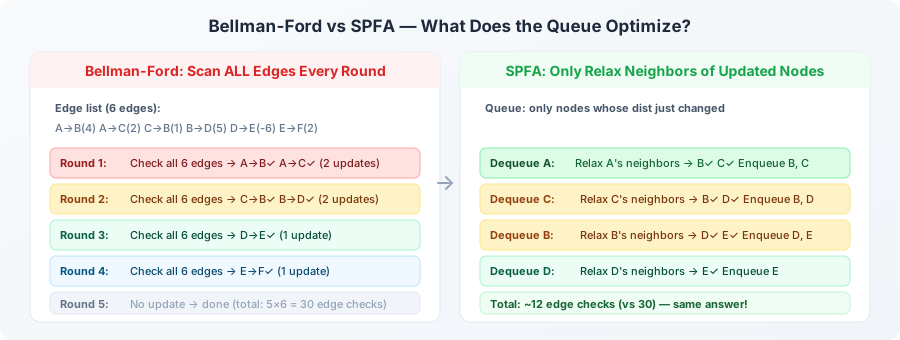
On the left, Bellman-Ford scans 6 edges per round — 30 checks across 5 rounds. On the right, SPFA only processes neighbors of updated nodes — about 12 checks total. Same results, far less work.
How the Queue Works
SPFA's structure is almost identical to BFS. The only difference: in BFS every node is enqueued exactly once; in SPFA a node can be enqueued multiple times (because its distance may be improved repeatedly).
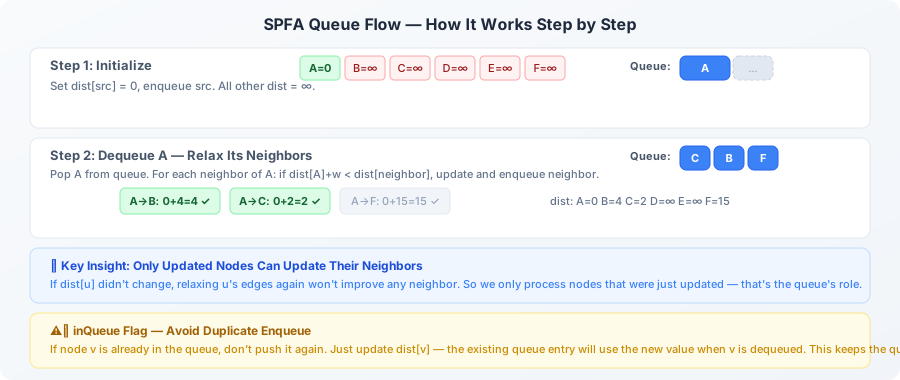
Key details:
| Point | Explanation |
|---|---|
| What goes in the queue | Nodes whose distance was just updated |
| What to do on dequeue | Iterate all outgoing edges, try to relax |
inQueue flag | If a node is already in the queue, don't enqueue it again (but dist is already updated — the existing entry will use the new value when dequeued) |
| Why can nodes re-enter | Negative edges can make the same path shorter multiple times; unlike Dijkstra which "locks" nodes, SPFA allows repeated improvement |
Step-by-Step Trace
Below we run SPFA on the exact same graph as Bellman-Ford, so you can compare the two algorithms side by side.

| Dequeue | Relaxations | dist array | Queue |
|---|---|---|---|
| — | Init: dist[A]=0, enqueue A | A=0, B=∞, C=∞, D=∞, E=∞, F=∞ | {A} |
| A | A→B(4)✓ A→C(2)✓ A→F(15)✓ | A=0, B=4, C=2, D=∞, E=∞, F=15 | {C, B, F} |
| C | C→B(1)✓ B:4→3; C→D(8)✓ | A=0, B=3, C=2, D=10, E=∞, F=15 | {B, F, D} |
| B | B→D(5)✓ D:10→8; B→E(7)✓ | A=0, B=3, C=2, D=8, E=10, F=15 | {F, D, E} |
| F | No improvement from F | Unchanged | {D, E} |
| D | D→E(-6)✓ E:10→2; D→F(4)✓ F:15→12 | A=0, B=3, C=2, D=8, E=2, F=12 | {E, F} |
| E | E→F(2)✓ F:12→4 | A=0, B=3, C=2, D=8, E=2, F=4 | {F} |
| F | No improvement | Unchanged | {} ← Empty, done! |
Final result: A→C→B→D→E→F = 2+1+5+(-6)+2 = 4 — identical to Bellman-Ford.
💡 Compared to Bellman-Ford: BF ran 5 rounds × 10 edges = 50 edge checks; SPFA did only ~18. The larger and sparser the graph, the bigger SPFA's advantage.
Negative Cycle Detection
Like Bellman-Ford, SPFA can also detect negative cycles:
- Principle: Without a negative cycle, a node can be enqueued at most V-1 times (corresponding to a shortest path with at most V-1 edges)
- Criterion: If a node is enqueued ≥ V times, a negative cycle exists
cnt[v]++;
if (cnt[v] >= n) return {};  // negative cycle!
⚠️ The code above detects negative cycles reachable from src. To detect any negative cycle in the graph (including unreachable parts), use a super-source — see below.
Complete Implementation
📄 View Code: SPFA
// SPFA (Bellman-Ford + queue optimization)
vector<ll> spfa(int src, int n) {
    vector<ll> dist(n + 1, INF);
    vector<bool> inQueue(n + 1, false);
    vector<int> cnt(n + 1, 0);   // cnt[v] = how many times v entered the queue

    queue<int> q;
    dist[src] = 0;
    q.push(src);
    inQueue[src] = true;

    while (!q.empty()) {
        int u = q.front(); q.pop();
        inQueue[u] = false;

        for (auto [w, v] : adj[u]) {
            if (dist[u] + w < dist[v]) {
                dist[v] = dist[u] + w;

                if (!inQueue[v]) {
                    q.push(v);
                    inQueue[v] = true;
                    cnt[v]++;

                    // Negative cycle: a node entering the queue >= n times
                    if (cnt[v] >= n) return {};  // negative cycle!
                }
            }
        }
    }
    return dist;
}
| Key Code | Purpose |
|---|---|
inQueue array | Prevents enqueuing the same node twice, keeping the queue lean |
cnt[v]++ | Tracks enqueue count for negative cycle detection |
inQueue[u] = false | Clears flag on dequeue, allowing the node to re-enter later |
Negative Cycle Detection for the Entire Graph
The SPFA above detects negative cycles reachable from src. To check whether the whole graph contains any negative cycle (including parts unreachable from src), set up a super-source:
📄 View Code: Detect negative cycles anywhere in the graph
// Detect a negative cycle anywhere (including unreachable parts).
// Add super-source 0 with 0-weight edges to every node, and run Bellman-Ford from 0.
bool hasNegativeCycle(int n) {
    // Original nodes are 1..n; super-source is 0
    vector<ll> dist(n + 1, 0);  // all start at 0 (equivalent to 0-weight edges from super-source)
    vector<bool> inQueue(n + 1, true);
    vector<int> cnt(n + 1, 0);
    queue<int> q;

    // Push every node (super-source effect)
    for (int i = 1; i <= n; i++) q.push(i);

    while (!q.empty()) {
        int u = q.front(); q.pop();
        inQueue[u] = false;

        for (auto [w, v] : adj[u]) {
            if (dist[u] + w < dist[v]) {
                dist[v] = dist[u] + w;
                if (!inQueue[v]) {
                    q.push(v); inQueue[v] = true;
                    if (++cnt[v] >= n) return true;  // negative cycle!
                }
            }
        }
    }
    return false;
}
When to Use SPFA
- All edges non-negative → Dijkstra is more stable
- Negative edges but no negative cycle, single-source shortest path → SPFA is the first choice (much faster than Bellman-Ford)
- Need to detect negative cycles reachable from the source → SPFA (enqueue-count criterion)
- Need to detect any negative cycle in the graph → Super-source + SPFA
⚠️ SPFA Worst Case: The worst-case time complexity is O(V × E) — identical to plain Bellman-Ford. On adversarially constructed graphs (common in competitive-programming "anti-SPFA" test data), SPFA degrades and may TLE. So: use Dijkstra whenever possible; only consider SPFA when negative edges exist.
💡 In one sentence: Bellman-Ford scans all edges every round; SPFA only relaxes neighbors of just-updated nodes — using a queue to skip useless edges, producing the same result, usually much faster.
5.4.7 Johnson's Algorithm — All-Pairs Shortest Paths
Floyd-Warshall is O(N³); running N Bellman-Fords is O(N²M). Johnson's algorithm reweights edges so that N runs of Dijkstra work on a graph with no negative edges, for a total of O(NM log M) — better than Floyd on sparse graphs.
Algorithm Steps
- Add a super-source 0 with 0-weight edges to every node
- Run Bellman-Ford from 0 to compute
h[i]= shortest distance from 0 to each node (if a negative cycle exists, no solution) - Reweight edges:
w'(u,v) = w(u,v) + h[u] - h[v](guaranteed ≥ 0) - Run Dijkstra from each node as a source (N times)
- Restore the real answer: actual shortest path = Dijkstra result −
h[s]+h[t]
📄 View Code: Johnson's Algorithm — O(NM log M)
// Johnson's All-Pairs Shortest Paths — O(NM log M)
#include <bits/stdc++.h>
using namespace std;
typedef long long ll;
const ll INF = 1e18;

int n, m;
// adj[u] = {v, w}; edges stores all edges for Bellman-Ford
vector<pair<int,ll>> adj[505];
struct Edge { int u, v; ll w; };
vector<Edge> edges;

vector<ll> bellman_ford(int s) {
    vector<ll> dist(n + 1, INF);
    dist[s] = 0;
    for (int i = 0; i < n; i++) {
        for (auto [u, v, w] : edges) {
            if (dist[u] != INF && dist[u] + w < dist[v])
                dist[v] = dist[u] + w;
        }
    }
    return dist;
}

vector<ll> dijkstra(int s, int n) {
    vector<ll> dist(n + 1, INF);
    priority_queue<pair<ll,int>, vector<pair<ll,int>>, greater<>> pq;
    dist[s] = 0; pq.push({0, s});
    while (!pq.empty()) {
        auto [d, u] = pq.top(); pq.pop();
        if (d > dist[u]) continue;
        for (auto [v, w] : adj[u]) {
            if (dist[u] + w < dist[v]) {
                dist[v] = dist[u] + w;
                pq.push({dist[v], v});
            }
        }
    }
    return dist;
}

// Returns dist[i][j] = true shortest path from i to j
// Returns INF if j is unreachable from i
vector<vector<ll>> johnson() {
    // Super-source n+1 with 0-weight edges to every node
    for (int i = 1; i <= n; i++)
        edges.push_back({n + 1, i, 0});

    // Bellman-Ford to get the potential h[]
    vector<ll> h = bellman_ford(n + 1);

    // Reweight edges (guaranteed non-negative)
    for (auto& e : edges) {
        if (e.u != n + 1)  // skip virtual edges from the super-source
            e.w += h[e.u] - h[e.v];
    }
    // Sync the adjacency list
    for (int u = 1; u <= n; u++)
        for (auto& [v, w] : adj[u])
            w += h[u] - h[v];

    // N runs of Dijkstra
    vector<vector<ll>> ans(n + 1, vector<ll>(n + 1, INF));
    for (int s = 1; s <= n; s++) {
        auto d = dijkstra(s, n);
        for (int t = 1; t <= n; t++) {
            if (d[t] != INF)
                ans[s][t] = d[t] - h[s] + h[t];  // restore true distance
        }
    }
    return ans;
}
💡 Why are reweighted edges non-negative? The triangle inequality gives
h[v] ≤ h[u] + w(u,v), sow'(u,v) = w(u,v) + h[u] - h[v] ≥ 0.
5.4.8 Reconstructing the Shortest Path
Use a pre[] array to record each node's predecessor, updated during relaxation:
📄 View Code: Record predecessors during relaxation and trace back
// Dijkstra with path reconstruction
vector<int> dijkstra_with_path(int src, int dst, int n) {
    vector<ll> dist(n + 1, INF);
    vector<int> pre(n + 1, -1);  // pre[v] = predecessor of v
    priority_queue<pair<ll,int>, vector<pair<ll,int>>, greater<>> pq;

    dist[src] = 0; pq.push({0, src});
    while (!pq.empty()) {
        auto [d, u] = pq.top(); pq.pop();
        if (d > dist[u]) continue;
        for (auto [v, w] : adj[u]) {
            if (dist[u] + w < dist[v]) {
                dist[v] = dist[u] + w;
                pre[v] = u;          // record predecessor
                pq.push({dist[v], v});
            }
        }
    }

    // Reconstruct path from pre[] (reversed)
    vector<int> path;
    for (int v = dst; v != -1; v = pre[v])
        path.push_back(v);
    reverse(path.begin(), path.end());

    // Check the path actually starts at src
    if (path.empty() || path[0] != src) return {};  // unreachable
    return path;  // src → ... → dst
}
When all edge weights are 1 (unweighted graph), BFS is just Dijkstra with a plain queue.
0-1 BFS: A powerful trick when edge weights are only 0 or 1, using a deque instead of a queue:
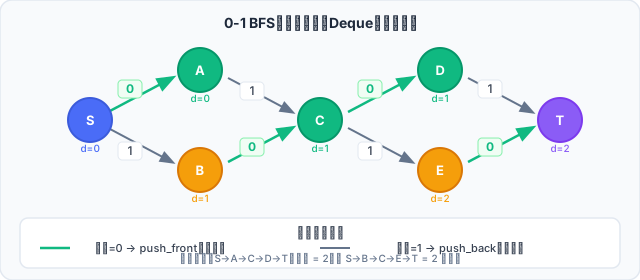
Deque:  [front → smallest dist ... → back → largest dist]

Relax neighbor v (via edge u→v of weight w):
  w = 0 → push_front(v)   (same distance as u — goes to the front)
  w = 1 → push_back(v)    (one step further — goes to the back)
💡 Efficiency: 0-1 BFS runs in O(V+E) — faster than Dijkstra's O((V+E) log V). Whenever edge weights are only 0 or 1, always prefer 0-1 BFS.
📄 View Code: 0-1 BFS
// 0-1 BFS — O(V + E) for {0,1} weight edges
vector<int> bfs01(int src, int n) {
    vector<int> dist(n + 1, INT_MAX);
    deque<int> dq;

    dist[src] = 0;
    dq.push_front(src);

    while (!dq.empty()) {
        int u = dq.front(); dq.pop_front();

        for (auto [w, v] : adj[u]) {
            if (dist[u] + w < dist[v]) {
                dist[v] = dist[u] + w;
                if (w == 0) dq.push_front(v);   // 0-weight: push front
                else        dq.push_back(v);    // 1-weight: push back
            }
        }
    }
    return dist;
}
5.4.8 Dijkstra on Grids
Many USACO problems involve grid-based shortest paths; the graph is implicit:
📄 View Code: Dijkstra on a grid
// Grid Dijkstra — shortest path from (0,0) to (R-1,C-1)
// Each cell has an entry cost
#include <bits/stdc++.h>
using namespace std;

typedef long long ll;
typedef tuple<ll,int,int> tli;

const ll INF = 1e18;
int dx[] = {0,0,1,-1};
int dy[] = {1,-1,0,0};

ll dijkstraGrid(vector<vector<int>>& grid) {
    int R = grid.size(), C = grid[0].size();
    vector<vector<ll>> dist(R, vector<ll>(C, INF));
    priority_queue<tli, vector<tli>, greater<tli>> pq;

    dist[0][0] = grid[0][0];
    pq.push({grid[0][0], 0, 0});

    while (!pq.empty()) {
        auto [d, r, c] = pq.top(); pq.pop();
        if (d > dist[r][c]) continue;

        for (int k = 0; k < 4; k++) {
            int nr = r + dx[k], nc = c + dy[k];
            if (nr < 0 || nr >= R || nc < 0 || nc >= C) continue;

            ll newDist = dist[r][c] + grid[nr][nc];
            if (newDist < dist[nr][nc]) {
                dist[nr][nc] = newDist;
                pq.push({newDist, nr, nc});
            }
        }
    }
    return dist[R-1][C-1];
}
⚠️ Five Classic Dijkstra Bugs
- Using
intinstead oflong long— distance sums overflow → silently wrong answers - Max-heap instead of min-heap — forgetting
greater<pii>→ processes the wrong node first - Missing the stale-entry check (
if (d > dist[u]) continue) — not wrong, but roughly 10× slower - Forgetting
dist[src] = 0— every distance stays INF - Using Dijkstra with negative edges — undefined behavior; may infinite-loop or return wrong answers
Chapter Summary
📌 Key Takeaways
| Algorithm | Complexity | Handles Neg | Use When |
|---|---|---|---|
| BFS | O(V+E) | ✗ No | Unweighted graphs |
| Dijkstra | O((V+E) log V) | ✗ No | Non-negative weighted SSSP |
| Bellman-Ford | O(V × E) | ✓ Yes | Negative edges, detect neg cycles |
| SPFA | O(VE) worst, fast avg | ✓ Yes | Sparse graphs, neg edges |
| Floyd-Warshall | O(V³) | ✓ Yes | All-pairs, V ≤ 500 |
| 0-1 BFS | O(V+E) | N/A | Edges with weight 0 or 1 only |
❓ FAQ
Q1: Why can't Dijkstra handle negative edges?
A: Dijkstra's greedy assumption is "the node with the current shortest distance cannot be improved by later paths." With negative edges, this assumption fails — a longer path through a negative edge may end up shorter. Conclusion: with negative edges you must use Bellman-Ford (
O(VE)) or SPFA (averageO(E), worstO(VE)).
Q2: What is the difference between SPFA and Bellman-Ford?
A: SPFA is a queue-optimized version of Bellman-Ford. Bellman-Ford traverses all edges each round; SPFA only updates neighbors of nodes whose distance improved, using a queue to track which nodes need processing. In practice SPFA is much faster (average
O(E)), but the theoretical worst case is the same (O(VE)).
Q3: Why must the k loop be the outermost in Floyd-Warshall?
A: This is the most common Floyd-Warshall implementation error! The DP invariant is: after the k-th outer loop iteration,
dist[i][j]represents the shortest path from i to j using only nodes {1, 2, ..., k} as intermediates. When processing intermediate node k,dist[i][k]anddist[k][j]must already be fully computed based on {1..k-1}. If k is in the inner loop,dist[i][k]may have just been updated in the same outer loop iteration, leading to incorrect results. Remember: k is outermost, i and j are inner — order matters!
Q4: How to determine whether a USACO problem needs Dijkstra or BFS?
A: Key question: Are edges weighted?
- Unweighted graph (edge weight=1 or find minimum edges) → BFS,
O(V+E), faster and simpler code- Weighted graph (different non-negative weights) → Dijkstra
- Edge weights only 0 or 1 → 0-1 BFS (faster than Dijkstra,
O(V+E))- Has negative edges → Bellman-Ford/SPFA
Q5: When to use Floyd-Warshall?
A: When you need shortest distances between all pairs, and V ≤ 500 (since
O(V³)≈ 1.25×10⁸ is barely feasible at V=500). Typical scenario: given multiple sources and targets, query distance between any pair. For V > 500, run Dijkstra once per node (O(V × (V+E) log V)) is faster.
🔗 Connections to Other Chapters
- Chapter 5.2 (BFS & DFS): BFS is "Dijkstra for unweighted graphs"; this chapter is a direct extension of BFS
- Chapter 5.4 (Binary Trees & Tree Algorithms): shortest path on a tree is the unique root-to-node path (DFS/BFS suffices)
- Chapter 6.1 (DP Introduction): Floyd-Warshall is essentially DP (state = "using first k nodes"); many shortest-path variants can be modeled with DP
- USACO Gold: shortest path + DP combos, shortest path + binary search, shortest path + data-structure optimization
Practice Problems
Problem 5.4.1 — Classic Dijkstra 🟢 Easy
Problem: Given N cities and M bidirectional roads, each with a travel time. Find the shortest travel time from city 1 to city N. Output −1 if unreachable.
Sample Input 1:
5 6
1 2 2
1 3 4
2 3 1
2 4 7
3 5 3
4 5 1
Sample Output 1: 6 (shortest path: 1→2→3→5, cost 2+1+3=6)
Sample Input 2: 3 cities, node 3 unreachable → Output: -1
💡 Hint
Standard Dijkstra from node 1. Use long long — max path = N × max_weight = 10^5 × 10^9 = 10^14, which overflows int.
✅ Full Solution
#include <bits/stdc++.h>
using namespace std;
typedef long long ll;
typedef pair<ll,int> pli;

int main() {
    ios_base::sync_with_stdio(false);
    cin.tie(NULL);

    int n, m;
    cin >> n >> m;

    vector<vector<pair<int,int>>> adj(n + 1);
    for (int i = 0; i < m; i++) {
        int u, v, w; cin >> u >> v >> w;
        adj[u].push_back({v, w});
        adj[v].push_back({u, w});
    }

    vector<ll> dist(n + 1, LLONG_MAX);
    priority_queue<pli, vector<pli>, greater<pli>> pq;

    dist[1] = 0;
    pq.push({0, 1});

    while (!pq.empty()) {
        auto [d, u] = pq.top(); pq.pop();
        if (d > dist[u]) continue;

        for (auto [v, w] : adj[u]) {
            if (dist[u] + w < dist[v]) {
                dist[v] = dist[u] + w;
                pq.push({dist[v], v});
            }
        }
    }

    cout << (dist[n] == LLONG_MAX ? -1 : dist[n]) << "\n";
    return 0;
}
// Time: O((N + M) log N),  Space: O(N + M)
Problem 5.4.2 — BFS on Grid 🟢 Easy
Problem: A robot starts at cell (0,0) of an R×C grid. Some cells are walls (#); others are passable (.). Find the minimum number of steps to reach (R-1, C-1). Output −1 if impossible.
✅ Full Solution
#include <bits/stdc++.h>
using namespace std;

int main() {
    ios_base::sync_with_stdio(false);
    cin.tie(NULL);

    int R, C;
    cin >> R >> C;

    vector<string> grid(R);
    for (auto& row : grid) cin >> row;

    vector<vector<int>> dist(R, vector<int>(C, -1));
    queue<pair<int,int>> q;

    if (grid[0][0] != '#') {
        dist[0][0] = 0;
        q.push({0, 0});
    }

    int dr[] = {-1, 1, 0, 0};
    int dc[] = {0, 0, -1, 1};

    while (!q.empty()) {
        auto [r, c] = q.front(); q.pop();
        for (int d = 0; d < 4; d++) {
            int nr = r + dr[d], nc = c + dc[d];
            if (nr >= 0 && nr < R && nc >= 0 && nc < C
                && grid[nr][nc] != '#' && dist[nr][nc] == -1) {
                dist[nr][nc] = dist[r][c] + 1;
                q.push({nr, nc});
            }
        }
    }

    cout << dist[R-1][C-1] << "\n";
    return 0;
}
Problem 5.4.3 — Negative Edge Detection 🟡 Medium
Problem: Given a directed graph with N nodes and M edges (possibly negative weights), find the shortest distance from node 1 to node N. If a negative cycle is reachable from 1 and can reach N, output "NEGATIVE CYCLE". If N is unreachable, output "UNREACHABLE".
✅ Full Solution
#include <bits/stdc++.h>
using namespace std;
typedef long long ll;

int main() {
    ios_base::sync_with_stdio(false);
    cin.tie(NULL);

    int n, m;
    cin >> n >> m;

    vector<tuple<int,int,ll>> edges(m);
    for (auto& [u, v, w] : edges) cin >> u >> v >> w;

    const ll INF = 1e18;
    vector<ll> dist(n + 1, INF);
    dist[1] = 0;

    // Bellman-Ford: V-1 passes
    for (int iter = 0; iter < n - 1; iter++) {
        for (auto [u, v, w] : edges) {
            if (dist[u] != INF && dist[u] + w < dist[v]) {
                dist[v] = dist[u] + w;
            }
        }
    }

    // V-th pass: detect negative cycles
    vector<bool> inNegCycle(n + 1, false);
    for (int iter = 0; iter < n; iter++) {
        for (auto [u, v, w] : edges) {
            if (dist[u] != INF && dist[u] + w < dist[v]) {
                dist[v] = dist[u] + w;
                inNegCycle[v] = true;
            }
            if (inNegCycle[u]) inNegCycle[v] = true;
        }
    }

    if (dist[n] == INF) cout << "UNREACHABLE\n";
    else if (inNegCycle[n]) cout << "NEGATIVE CYCLE\n";
    else cout << dist[n] << "\n";

    return 0;
}
Problem 5.4.4 — Multi-Source BFS: Zombie Outbreak 🟡 Medium
Problem: A zombie outbreak starts at K infected cities simultaneously. Each time unit, zombies spread to all adjacent (uninfected) cities. Find the minimum time for zombies to reach every reachable city; output −1 for cities that can never be reached.
💡 Hint
Multi-source BFS: push all K infected cities into the queue at time 0, then run BFS normally. This is equivalent to adding a virtual "super-source" connected to all K cities with 0-weight edges.
✅ Full Solution
#include <bits/stdc++.h>
using namespace std;

int main() {
    ios_base::sync_with_stdio(false);
    cin.tie(NULL);

    int n, m, k;
    cin >> n >> m >> k;

    vector<vector<int>> adj(n + 1);
    for (int i = 0; i < m; i++) {
        int u, v; cin >> u >> v;
        adj[u].push_back(v);
        adj[v].push_back(u);
    }

    vector<int> dist(n + 1, -1);
    queue<int> q;

    // Push ALL K zombie sources at time 0
    for (int i = 0; i < k; i++) {
        int z; cin >> z;
        dist[z] = 0;
        q.push(z);
    }

    // Standard BFS from all sources simultaneously
    while (!q.empty()) {
        int u = q.front(); q.pop();
        for (int v : adj[u]) {
            if (dist[v] == -1) {
                dist[v] = dist[u] + 1;
                q.push(v);
            }
        }
    }

    for (int u = 1; u <= n; u++) {
        cout << dist[u];
        if (u < n) cout << " ";
    }
    cout << "\n";
    return 0;
}
Problem 5.4.5 — All-Pairs with Floyd 🟡 Medium
Problem: Given N cities (N ≤ 300) and M roads, answer Q queries: "Is the distance between cities u and v at most D?"
✅ Full Solution
#include <bits/stdc++.h>
using namespace std;
typedef long long ll;

int main() {
    ios_base::sync_with_stdio(false);
    cin.tie(NULL);

    int n, m;
    cin >> n >> m;

    const ll INF = 1e18;
    vector<vector<ll>> dist(n + 1, vector<ll>(n + 1, INF));

    for (int i = 1; i <= n; i++) dist[i][i] = 0;

    for (int i = 0; i < m; i++) {
        int u, v; ll w;
        cin >> u >> v >> w;
        dist[u][v] = min(dist[u][v], w);
        dist[v][u] = min(dist[v][u], w);
    }

    // Floyd-Warshall: O(N³)
    for (int k = 1; k <= n; k++)
        for (int i = 1; i <= n; i++)
            for (int j = 1; j <= n; j++)
                if (dist[i][k] != INF && dist[k][j] != INF)
                    dist[i][j] = min(dist[i][j], dist[i][k] + dist[k][j]);

    int q;
    cin >> q;
    while (q--) {
        int u, v; ll D;
        cin >> u >> v >> D;
        cout << (dist[u][v] <= D ? "YES" : "NO") << "\n";
    }

    return 0;
}
// Time: O(N³ + Q),  Space: O(N²)
Problem 5.4.6 — Maximum Bottleneck Path 🔴 Hard
Problem: Given N cities connected by M roads, each with a weight limit (the maximum cargo weight it can carry), find the path from city 1 to city N that maximizes the minimum edge weight along the path — i.e., the heaviest cargo that can be shipped in one trip.
💡 Hint
Modified Dijkstra: instead of minimizing total cost, maximize the bottleneck. Let dist[v] = the maximum minimum-edge-weight over any path to v. Use a max-heap. Relaxation: dist[v] = max(dist[v], min(dist[u], weight(u,v))).
✅ Full Solution
#include <bits/stdc++.h>
using namespace std;
typedef pair<int,int> pii;

int main() {
    ios_base::sync_with_stdio(false);
    cin.tie(NULL);

    int n, m;
    cin >> n >> m;

    vector<vector<pii>> adj(n + 1);
    for (int i = 0; i < m; i++) {
        int u, v, w; cin >> u >> v >> w;
        adj[u].push_back({v, w});
        adj[v].push_back({u, w});
    }

    // Modified Dijkstra: maximize bottleneck
    vector<int> dist(n + 1, 0);
    priority_queue<pii> pq;  // max-heap: {bottleneck, node}

    dist[1] = INT_MAX;
    pq.push({INT_MAX, 1});

    while (!pq.empty()) {
        auto [d, u] = pq.top(); pq.pop();
        if (d < dist[u]) continue;

        for (auto [v, w] : adj[u]) {
            int newBottleneck = min(dist[u], w);  // ← KEY: min along the path
            if (newBottleneck > dist[v]) {
                dist[v] = newBottleneck;
                pq.push({dist[v], v});
            }
        }
    }

    cout << dist[n] << "\n";
    return 0;
}
// Time: O((N + M) log N),  Space: O(N + M)
End of Chapter 5.4 — Next: Chapter 6.1: Introduction to DP